
How Argentina’s Flat Four Nearly Ended Their World Cup 2026 Dream
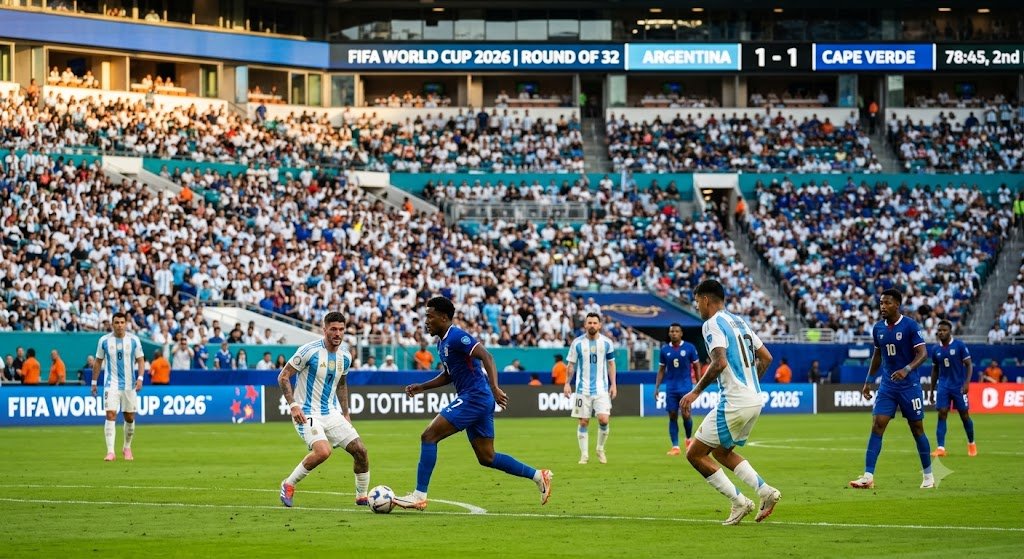
Cape Verde produced 0.47 expected goals against a team that had conceded almost nothing all tournament, and still came within one deflection of the biggest shock in World Cup history. Argentina beat Cape Verde 3-2 after extra time at Hard Rock Stadium in Miami Gardens on July 4, 2026, in their World Cup 2026 Round of 32 tie. Lionel Messi opened the scoring in the 29th minute, Deroy Duarte equalized in the 59th, Lisandro Martinez restored the lead in extra time, Sidny Cabral levelled again with a stunning strike in the 103rd, and Diney Borges turned the ball into his own net in the 111th to send Argentina through to face Egypt.
That is the scoreline. It does not explain how a team ranked 63rd in the world, playing their first ever World Cup knockout match, spent long stretches of this game as the better side.
Everyone will point to the own goal and call this a routine survival. They are missing what actually happened between the 45th and 105th minutes, when Cape Verde’s 4-1-4-1 repeatedly found the exact gap Lionel Scaloni’s 4-4-2 was built to leave open.
Why Cape Verde’s Midfield Diamond Kept Finding Space
Argentina’s flat midfield four of Rodrigo De Paul, Alexis Mac Allister, Enzo Fernandez and Thiago Almada is built for control against teams willing to sit deep and let Messi dictate tempo. Cape Verde did the opposite. Kevin Pina sat as a lone holding midfielder and let Ryan Mendes and Jovane Cabral push high and wide, stretching Argentina’s back four horizontally rather than trying to break them down the middle.
The mismatch showed immediately after halftime. Argentina had produced 0.41 xG in the first half without much resistance, but Cape Verde came out for the second period and won the ball back inside twelve seconds of the restart on three separate occasions inside the opening ten minutes. Deroy Duarte’s equalizer in the 59th was not an accident. Mendes received the ball in space between Nahuel Molina and Cristian Romero, the exact seam a flat back four cannot cover when both fullbacks are still upfield from a set piece minutes earlier.
Here’s the thing Argentina’s 2.26 xG for the match looks dominant on paper. Strip away the two free kicks and the eventual own goal, and their run of play from open play produced fewer clean looks than Cape Verde managed on the counter.
The Substitution That Actually Changed the Shape
Scaloni’s response arrived late. Julian Alvarez and Nico Gonzalez came on together in the 63rd and 64th minutes, but the more important shift was tactical rather than personnel. Alvarez dropped deeper than Lautaro Martinez had been playing, effectively turning the 4-4-2 into something closer to a 4-2-3-1 with Messi as the furthest man forward and Alvarez linking the midfield to him.
It did not fix things immediately. Cape Verde still forced Emiliano Martinez into saves from Deroy Duarte and later peppered him with corners deep into extra time. But the extra body in central midfield meant Argentina stopped conceding the transition moments that had defined the second half, and it set up the platform for Mac Allister’s headed knockdown that Lisandro Martinez smashed home in the 92nd minute.
Kevin Pina’s yellow card in the 68th, for a foul that stopped Messi mid-run, also mattered more than it looked at the time. Cape Verde’s only holding midfielder now had to manage every challenge with the knowledge that a second card would leave his side with ten men in extra time against the reigning champions. That single card quietly limited how aggressively Bubista could press for the rest of the match.
Cape Verde deserve enormous credit for a defensive scheme that held Spain and Uruguay scoreless earlier in the tournament, and for one specific individual moment in this one. Sidny Cabral’s goal in the 103rd was not a product of any system. He cut inside from left back, opened his body against three white shirts, and curled a shot into the top corner that would have won any match at this tournament on its own merit.
Vozinha, at 40 years old, made eight saves and turned away five efforts from Messi alone. Cape Verde’s game plan of inviting Argentina forward and hitting them with pace in behind was sound. What ended it was not tactics. It was a deflection off Borges’ arm that Vozinha had no chance of reaching.
Scaloni got one thing unmistakably right across the full 120 minutes: he never abandoned Messi’s central role even as the middle of the pitch turned chaotic. Every Argentina goal, direct or deflected, traced back through either a Messi pass or a set piece he delivered. That structural loyalty to his most dangerous player, even while the team around him wobbled, is what eventually separated a champion from a team that was ninety seconds from a penalty shootout against a nation making its World Cup debut.
For all the talk about Argentina cruising into the last 16, the tape says something different. Scaloni needs his double pivot compact before facing Egypt, not stretched across the width of the pitch chasing wide overloads. Sit De Paul and Mac Allister ten yards narrower against a side that will also look to isolate fullbacks, and this problem does not reappear in Atlanta.
Messi scored his 20th World Cup goal and extended a record that may never be touched again. Full stop. But the story of this match belongs just as much to a back four that spent forty minutes searching for an answer it never quite found on its own.