
Morocco Exposed Brazil’s Halftime Reshuffle Before Vinicius Saved It
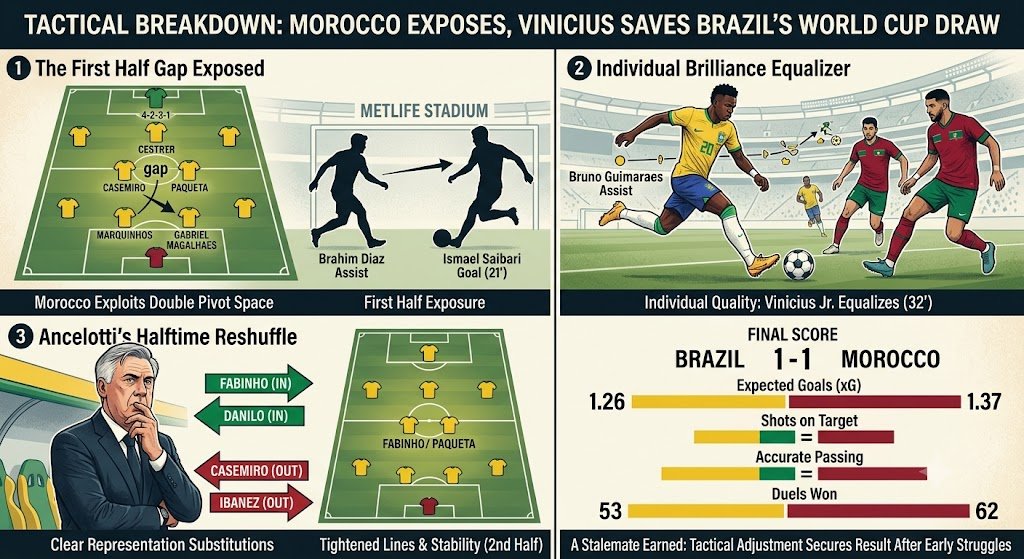
A 27-yard pass split two Brazil center backs clean in half. That single ball from Brahim Diaz, slipped between Gabriel Magalhaes and Marquinhos, set up Ismael Saibari for the opening goal and told you everything about how this Group C match would go.
Brazil and Morocco drew 1-1 at MetLife Stadium in East Rutherford on June 14, 2026, in a Group C match at the World Cup. Saibari put Morocco ahead in the 21st minute, chipping the ball over a slow-reacting Alisson Becker after Diaz’s pass found him in space at the top of the box. Vinicius Junior leveled things 11 minutes later, finishing off a Bruno Guimaraes assist with a low right-footed strike. Carlo Ancelotti made two changes at the break and the game settled into a stalemate from there.
Here is the headline version for anyone short on time. Brazil and Morocco finished level on shots on target, level on accurate passing, and nearly level on expected goals, with Morocco actually edging that number 1.37 to 1.26. This was not a draw Brazil were unlucky to get. It was closer to the result both xG totals predicted.
Strip away the noise and one pattern explains both the goal conceded and most of Morocco’s first-half dominance.
Both sides lined up in a 4-2-3-1, which on paper should produce a fairly even midfield battle. It did not. Morocco’s front four, Diaz, Saibari, Bilal El Khannouss and Neil El Aynaoui, kept finding pockets of space between Brazil’s double pivot of Casemiro and Lucas Paqueta and the back four. That gap is the space a double pivot is supposed to close by sitting deep and narrow while staying connected to the defense, and for the opening half hour Brazil’s pivot did neither well.
The goal itself came from individual error as much as system failure.
Paqueta lost control of a pass from Roger Ibanez, the ball ran loose, Morocco pounced, and within three touches Diaz had threaded it through for Saibari. But individual mistakes get punished harder when the team shape is not protecting against them, and Brazil’s shape left exactly the lane Morocco needed.
Ancelotti’s response was decisive rather than cosmetic. He pulled Ibanez and Casemiro at halftime for Danilo and Fabinho, a double change before the second half had even started. That is not a tweak. That is an admission that the back four and the pivot both needed resetting. Brazil conceded nothing else for the remaining hour, which suggests the swap did its job defensively, even if it never fully solved their attacking spark either.
Morocco’s first-half performance deserves more credit than a 1-1 final score usually gets a losing-the-lead side.
Walid Regragui’s team out-dueled Brazil 62 to 53 in total duels won and forced more shots overall, 14 to 12. Achraf Hakimi caused problems down the right all match, and Noussair Mazraoui led all defenders in defensive interventions before going off in the 80th minute. For a team that had to play most of the second half without El Khannouss and Diaz, both substituted by the 80th minute, holding a draw against five-time champions away from home, in conditions that hit 88 degrees Fahrenheit, says plenty about their fitness and discipline.
Vinicius Junior’s goal, in fairness, was pure individual quality. Guimaraes worked the ball to him on the left, he created half a yard with two touches, and he beat Yassine Bounou far side. That is not a structural pattern. That is one of the best players alive doing what he does.
Make no mistake, the deeper issue for Brazil sits in central midfield, not at the back. Ancelotti’s most useful fix here is not personnel. It is instructing whichever pivot pairing starts against Scotland to stay five to eight yards tighter to the back four whenever the opposition’s number ten drops between the lines, closing exactly the route Diaz exploited rather than reacting to it after the fact.
Brazil are unbeaten. They are also not yet the team their name suggests.