
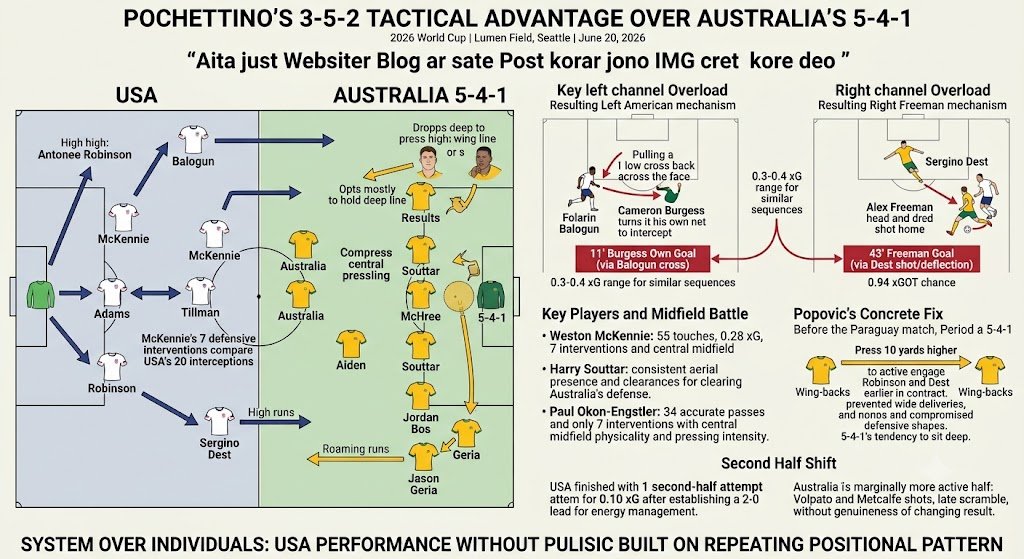
Pochettino’s 3-5-2 Overloaded Australia’s Wide Channels Before Half-Time at the 2026 World Cup
Both goals came from the same corridor. Folarin Balogun driving left, Sergino Dest arriving late from the right wing-back slot, deliveries into a central area where Australia’s 5-4-1 had no spare defender to cover. The United States beat Australia 2-0 at Lumen Field in Seattle on June 20, 2026, in their Group D match at the 2026 World Cup. Cameron Burgess turned a Balogun cross into his own net in the 11th minute, and Alex Freeman headed in Dest’s deflected shot in the 43rd minute after a VAR review confirmed the goal.
The USA finished with 1.08 xG and six corners. Australia ended the first half with a combined xG of 0.32 from five total attempts, and never genuinely threatened to change the result.
Both of those things are worth sitting with. The USA generated 0.68 xG from set pieces alone. They created their goals not through individual moments of quality but through a repeating positional pattern that Tony Popovic’s setup had no answer for across 45 minutes.
Mauricio Pochettino’s 3-5-2 sent wing-backs Antonee Robinson on the left and Dest on the right very high and very early. In a 3-5-2, the wing-backs are the widest players on the pitch they function as attacking fullbacks and wide midfielders simultaneously, stretching the opposition across the full width of the field. Against Australia’s 5-4-1, which relies on its own wide wing-backs tucking in to form a narrow defensive line when under pressure, those high runs created an immediate problem.
Australia’s wing-backs Jordan Bos and Jason Geria were caught between following Robinson and Dest which left their own defensive line short or holding their line and leaving the Americans with uncontested space in wide areas. Bos and Geria mostly chose to hold. Dest and Robinson exploited the resulting space relentlessly.
The Burgess own goal came from exactly this pattern. Balogun received the ball on the left channel and drove toward the byline before pulling a low cross back across the face of goal. Burgess, tracking the movement, turned the ball into his own net trying to intercept. The xG value is not logged as a standard chance, being an own goal, but the cross delivery from that position with defenders having to redirect at pace sits in the 0.3 to 0.4 range for similar sequences.
Freeman’s goal at 43 minutes was the same mechanism from the other side. Dest arrived from his wide right position and drove a shot at goal that deflected into the path of Freeman at four yards, who headed home at 0.94 xGOT. An almost certain goal from a chance created by the identical overlapping run that had been generating pressure since the fifth minute. Pochettino’s system did not change between the 11th minute and the 43rd. It did not need to. Australia had no solution in either of them.
Weston McKennie’s role in midfield deserves specific attention. He finished with 55 touches and 0.28 xG from two shots, but the more important number is his seven defensive interventions. The 3-5-2 relies on the central three midfielders compressing centrally when the ball is lost, so that the wide wing-backs can push high without leaving space behind. McKennie, Tyler Adams, and Malik Tillman all sat in that central band and stepped across aggressively every time Australia tried to play through the middle. It produced 20 interceptions for the USA across the game. Australia managed just six. Popovic’s side could not build through the center because there was no center to build through just three pressing bodies who had clearly been told exactly where to stand.
Australia’s best asset on the day was the aerial presence of Harry Souttar at center-back. Souttar won clearances and defensive headers consistently across the first half, finished with multiple interventions, and was the primary reason Australia’s xG from set pieces remained low despite the USA winning seven corners. Souttar’s aerial ability would have been more useful if Australia had matched the USA’s physicality in central midfield, which they did not. Paul Okon-Engstler had 34 accurate passes and just seven defensive interventions a player clearly more comfortable receiving possession than winning it back.
Popovic made three changes at half-time. Nestory Irankunda replaced Mohamed Toure up front, and adjustments were made to the midfield structure. None of it changed the fundamental shape. Australia continued to sit in a low 5-4-1 in the second half, inviting the USA to have the ball, and the Americans obliged by barely testing them. The USA had just one second-half attempt that added 0.10 to their xG. With a two-goal lead and an eye on managing energy before the knockouts, that was a rational choice. For Australia, the second half was marginally more active Cristian Volpato and Connor Metcalfe both had shots, and a late scramble in the 85th minute saw Jason Geria’s blocked effort produce the most frantic Australian moment of the match but none of it came close to a goal that would have changed the story.
For Popovic, the concrete fix before the Paraguay match is about how Australia defend wide deliveries against a three-man back line with attacking wing-backs. His wing-backs need explicit instructions to press the USA’s wing-backs as they receive rather than dropping toward their own defensive line. The moment Robinson or Dest received the ball facing forward with space ahead of them, Australia’s shape was already compromised. If Bos and Geria step and engage 10 yards higher, the delivery angle changes, the cross arrives under more pressure, and the entire sequence that produced both goals looks different. Sitting deep invites the width. Pressing earlier forces the problem back where Australia can manage it.
Still, the USA did this without Christian Pulisic. That is the real headline.
A performance built on system rather than on one irreplaceable player is the kind that wins tournaments.