
A Substitute Beat Portugal With The Move Their Own Bench Never Found
One second-half substitute assisted another second-half substitute, and that was the entire difference between a World Cup exit and a quarterfinal place. Spain beat Portugal 1-0 at AT&T Stadium in Arlington, Texas, on July 7, 2026, in the Round of 16, with Ferran Torres teeing up fellow substitute Mikel Merino in the first minute of stoppage time. Cristiano Ronaldo’s likely final World Cup appearance ended not with a moment of magic from him, but with a tactical pattern he had no answer for.
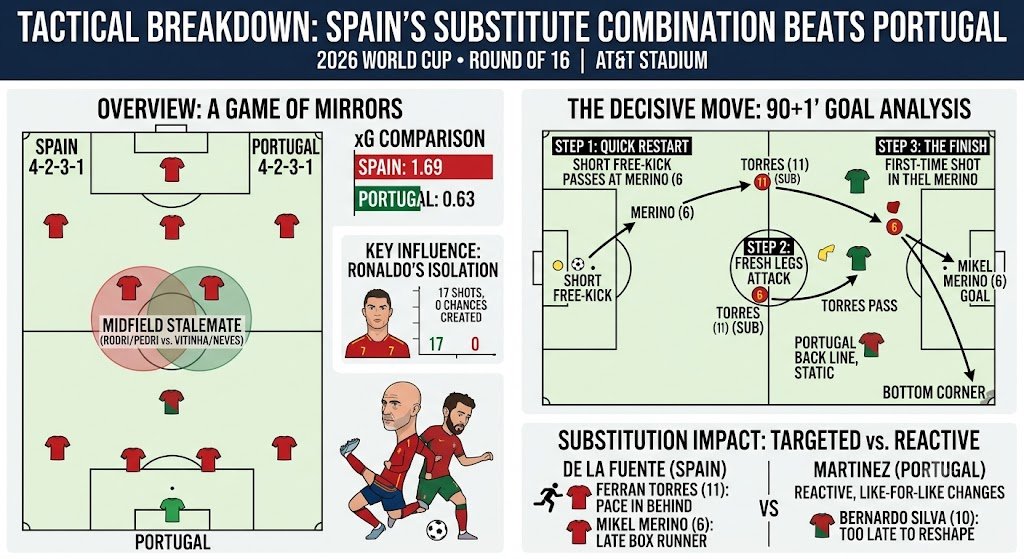
Spain won 1-0. Merino scored in the 90th plus first minute, slotting a low finish from Torres’ pass after a quickly worked free kick. Portugal never had an answer, finishing with just 0.63 expected goals to Spain’s 1.69. That gap tells most of the story before a single tactic gets explained.
The 4-2-3-1 Mirror That Cancelled Itself Out
Both sides lined up in a 4-2-3-1, which on paper should have produced an open, stretched match. Instead it produced a stalemate for long spells, because Rodri and Pedri sitting deep for Spain matched up almost perfectly against Vitinha and Joao Neves screening for Portugal. Neither midfield pair could break the other down through the center, so the game got pushed to the flanks and then, for most of the second half, nowhere at all.
Here is the thing. Spain still generated far more of their threat from wide areas, using Lamine Yamal cutting in from the right and Alex Baena drifting from the left. Portugal, in contrast, leaned almost entirely on Ronaldo’s individual movement rather than a repeatable pattern, and one striking statistic exposed it. Ronaldo attempted 17 shots across the tournament without creating a single chance for a teammate, the most shots by any player in a World Cup edition since 1966 without one assist opportunity created.
That is not a knock on effort. It is a description of a team with no second source of danger.
How the Winning Goal Actually Came Together
Spain’s goal did not come from open-play buildup. It came from a quickly taken free kick, worked short to Fabian Ruiz, who found Torres, who then slipped a defense-splitting pass through for Merino to finish first time. The pattern mattered more than any individual moment. Portugal’s back line, set on their heels by the sudden restart, never organized in time to press the ball or track the late run.
This was not luck. Spain had already shown, twenty minutes earlier through Dani Olmo and Pedri combining centrally, that they could unlock Portugal’s low block with quick combination play rather than crosses. Manager Luis de la Fuente sent on Torres and Merino specifically to add fresh legs capable of executing exactly that kind of pass and run when Portugal’s defenders started to tire.
The Substitution Battle Spain Won Clearly
Roberto Martinez used his five changes reactively, swapping like for like at fullback and adding attacking bodies without changing his team’s approach. Bernardo Silva came on, had a golden headed chance in stoppage time, but arrived too late to reshape the game’s rhythm. Rafael Leao and Joao Felix rotated through the same central channel Ronaldo had already occupied all match, adding numbers without adding a new attacking angle.
De la Fuente’s changes did the opposite. Torres brought pace in behind that Baena had not offered, and Merino brought a runner arriving late into the box rather than starting deep. Two specific, different problems for Portugal’s tired legs to solve in the final ten minutes. Only one team’s bench actually altered how the ball moved.
What Portugal Did Well Before It Fell Apart
Portugal were not run over. Nuno Mendes had an excellent match down the left before injury forced him off, and his 41st-minute strike cannoning off the crossbar via a deflection off Pedro Porro was the closest either side came to a first-half goal. Portugal also won 47 duels to Spain’s 35 and committed to a compact defensive shape that limited Spain to 1.69 expected goals across ninety-plus minutes, a modest tally for a team that dominated territory.
Diogo Costa deserves real credit too. His double save from Yamal and Baena in the 16th minute kept the match level when Spain looked ready to run away with it. Still, containing danger is not the same as creating it, and Portugal managed only 0.63 expected goals of their own.
The Fix Martinez Needed and Never Found
Portugal’s actual problem was not Ronaldo’s age or Ronaldo’s finishing. It was that Bruno Fernandes and Joao Felix kept feeding him in areas Spain’s back line had already scouted, wide and static, rather than creating a second passing lane through midfield the way Spain used Olmo and Pedri. A double pivot capable of driving forward rather than just screening, brought on earlier than the 83rd minute, might have given Fernandes a genuine second option instead of a static target.
Spain move on. Portugal go home, and Ronaldo goes with them. He spent the entire match creating shots for himself and none for anyone else. In the end, that arithmetic caught up with his team exactly when it mattered most.