
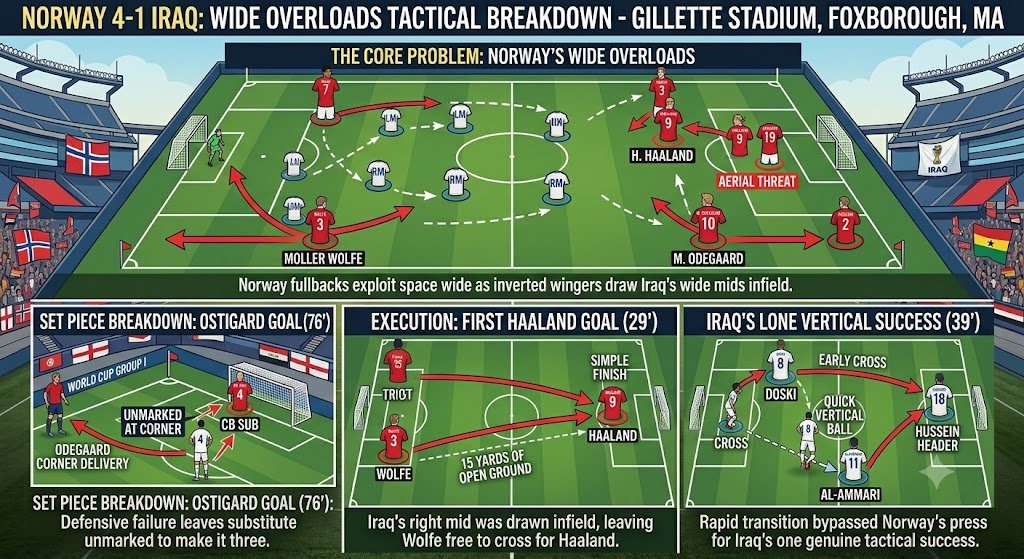
Norway’s Wide Overloads Exposed Iraq’s Flat 4-4-2 From the First Minute 2026 World Cup Group I
Norway beat Iraq 4-1 at Gillette Stadium in Foxborough, Massachusetts on June 17, 2026, in their Group I opener at the 2026 World Cup. Erling Haaland scored in the 29th and 43rd minutes, Leo Ostigard headed in a corner in the 76th, and Aymen Hussein turned the ball into his own net in stoppage time. Hussein had earlier pulled one back for Iraq with a header in the 39th. Norway finished with 2.52 xG; Iraq managed 0.80.
Both sides lined up in a 4-4-2 four defenders, four midfielders in a flat line, two strikers up top. On paper that sounds even. In practice, Norway’s version was fluid and positional; Iraq’s was rigid and static. Every Norway goal came from the same source: wide deliveries into a crowded penalty area where Haaland and Alexander Sorloth created aerial threats that Iraq’s centre-backs could not handle consistently. That pattern was visible from the first ten minutes and Iraq found no answer for it across ninety.
Norway’s wide midfielders, Antonio Nusa on the left and Martin Odegaard on the right, did not stay wide. They moved inside when Norway had the ball, pulling Iraq’s wide midfielders Zaid Ismael and Ibrahim Bayesh towards the centre of the pitch and opening the channels for David Moller Wolfe and Torbjorn Heggem to push forward from full-back into space. Moller Wolfe’s low cross from the left in the 29th minute came directly from this pattern: he had fifteen yards of open ground before he cut it back, and Haaland was waiting at the back post with a simple finish. Iraq’s right midfielder had been pulled infield and simply was not there to stop him.
The second goal was even more revealing of Iraq’s structural problem. Goalkeeper Jalal Hassan received a back pass under no real pressure in the 43rd minute and, instead of playing it wide to a defender, attempted a clearance that went straight to Haaland six yards out. Hassan could not control the situation, his touch only deflected the ball back into danger, and Haaland finished. That is not a goalkeeping error in isolation it is the consequence of a team that had been pressed hard for forty minutes and had not practised what to do when the goalkeeper was the last resort. Hassan’s xG conceded was 2.52 against four goals conceded. He saved two close-range efforts and was not at fault for the goals that went in.
Iraq’s one genuine tactical success was the equaliser. Merchas Doski, the holding midfielder who ended the game with five tackles won and eleven duels won the most of any player on the pitch dropped deep to receive the ball and immediately played it forward at pace, bypassing Norway’s press. Amir Al-Ammari ran the channel on the left and crossed first time; Hussein met it with a clean header at the near post that gave Norway goalkeeper Orjan Nyland no chance. That move quick vertical ball, run in behind, early cross was exactly what Iraq needed to do more often, and they did it precisely once.
Here is the thing Iraq actually had the better of first-half stoppage time after the equaliser. Al-Hamadi had a shot blocked, Bayesh fired narrowly wide from seven yards, Tahseen headed over at the back post. Combined xG from that spell alone: roughly 0.44. Had any of those fallen differently, the second half becomes a genuinely open game. Instead, Haaland’s goal in the 43rd meant Norway went in at the break leading 2-1, and Iraq’s window was effectively closed.
Ståle Solbakken’s four substitutions at 73 minutes all at once served two purposes: protect players from injury with a game already won, and give the bench competitive minutes before the Senegal match. Ostigard came on to replace the injured Moller Wolfe, and within three minutes had headed home Odegaard’s corner at the back post. Leo Ostigard. A central defender. Unmarked at a corner. Iraq’s set-piece organisation which requires the defensive players to pick up runners as they move towards the ball simply left the substitute free at the back post.
For Iraq’s coach looking at the France match ahead, the fix is specific and structural. Iraq’s wide midfielders cannot follow Norway’s inverted movement all the way inside. When Nusa or Odegaard drifted towards the centre, Ismael and Bayesh followed, which left Moller Wolfe and Heggem free on the outside. Iraq need their wide midfielders to hold the touchline position stay out wide rather than tracking the runner inside so that the full-backs cannot push forward. Let the centre-backs deal with the inverted winger; use the wide midfielder to block the overlapping run. France will do exactly what Norway did. If Iraq follow the same runners inside again, they will concede from the same positions again.
Verdict: Norway were the better side, their system was the better system, and the scoreline reflects reality. Iraq made one brilliant counter-attacking goal and spent the rest of the game being pulled apart in wide areas by a team that knew exactly where the space would be.