
Congo DR’s 5-3-2 Counter System Outperformed Portugal’s 4-2-3-1 at the 2026 World Cup
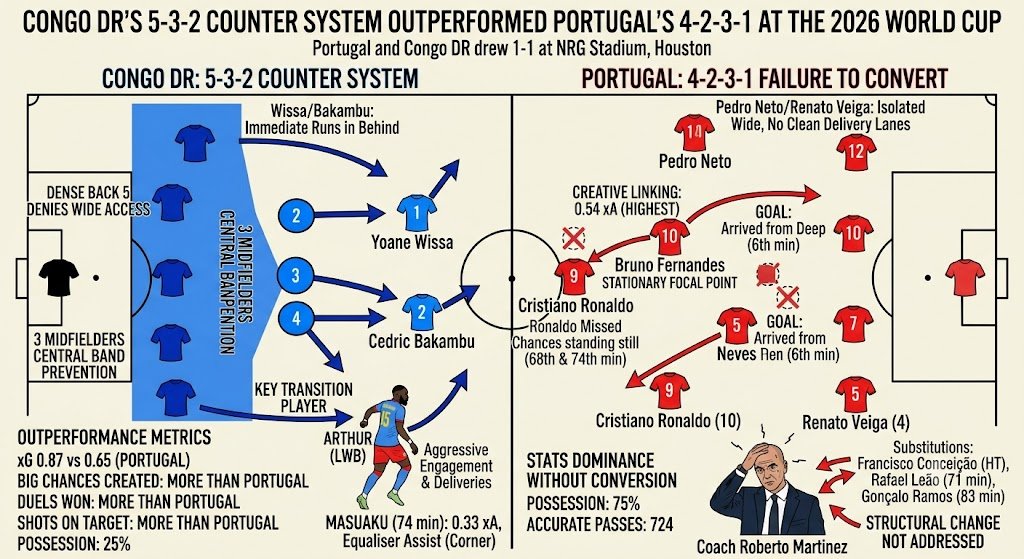
Portugal had 75% possession. They completed 724 accurate passes. They generated 0.65 xG against a side making only their second World Cup appearance in 52 years. Congo DR generated 0.87 xG and looked the more likely winners for large portions of the second half. Portugal and Congo DR drew 1-1 at NRG Stadium in Houston on June 17, 2026, in their Group K opener at the 2026 World Cup. Joao Neves headed Portugal in front from Pedro Neto’s cross in the sixth minute. Yoane Wissa equalised in first-half stoppage time with a header from Arthur Masuaku’s corner delivery. The coach who left Houston with a stronger tactical position was not Roberto Martinez.
That sentence requires some unpacking, because the immediate reading of the result is that Congo DR clung on bravely against a superior opponent. The actual picture is different. Congo DR finished with more xG, more big chances created, more duels won, and more shots on target than Portugal. Not marginally. They outperformed the European side on four of the five key attacking metrics despite touching the ball a quarter of the time. That is not luck. That is a system working.
Vitor Dias set his side up in a 5-3-2 five defenders across the back, three midfielders compressed centrally, and two forwards operating in tight tandem high up the pitch. The function of this shape is to deny Portugal’s wide players any dangerous crossing positions, absorb the inevitable possession, and transition quickly the moment the ball is won back. The three midfielders sat in a narrow band and never pushed high enough to expose the back five, which meant Portugal’s wide players Pedro Neto on the left, Renato Veiga on the right found space out wide but no clean delivery lanes from it. Portugal registered just six accurate crosses across the entire match.
Congo DR’s key player in transition was Arthur Masuaku from his left wing-back position. Masuaku finished with 0.33 xA expected assists, which measures the quality of deliveries and assisted the equaliser from a corner. His role was not to defend and stay but to engage aggressively when Congo DR had the ball and deliver from wide left before Portugal’s shape could reorganise. He had 34 touches and was substituted at the 74th minute, by which point his impact on Portugal’s back line had already been felt repeatedly.
The equaliser came from a pattern that had been building. Portugal’s set-piece defense allowed Congo DR’s taller players to isolate and attack crosses in congested areas. Steve Kapuadi headed wide from eight yards in the 63rd minute at 0.19 xG a chance Portugal should have been better organised to prevent. Wissa’s goal in first-half stoppage time from Masuaku’s corner delivery carried 0.39 xG and 0.81 xGOT. He arrived unmarked at the near post and headed into the top left corner. The delivery was well-placed, but the unmarked arrival was a defensive failure.
Portugal’s 4-2-3-1 relies on Bruno Fernandes operating in the number ten role the player who sits between midfield and the forward line, linking play and driving runners into the penalty area. Fernandes finished with 0.54 xA, the highest of any Portugal player, but the delivery was consistently finding Ronaldo arriving at the near post from tight angles. Ronaldo missed at 11 yards in the 68th minute at 0.24 xG, and again from a similar position at the 74th minute at 0.18 xG. Both shots went wide right. The runs and the service were creditable. The execution was not.
Martinez made four substitutions, none of which changed what Portugal were doing structurally. Francisco Conceicao came on for Bernardo Silva at half-time and brought more directness on the right flank. Rafael Leao replaced Neto at 71 minutes and also drove at the defense with pace. Goncalo Ramos came on for Vitinha in the 83rd minute, which finally gave Portugal a second striker option rather than Ronaldo as sole focal point. All of these were correct decisions in isolation. None of them addressed the fundamental problem: Portugal were creating chances but converting them at a rate far below what the xG suggested was sustainable.
For all their industry, Congo DR did one thing exceptionally well on the ball that deserves recognition. Their counter-attack structure was clear and repeatable. The moment possession was regained in their own half, Wissa and Cedric Bakambu made immediate runs in behind Portugal’s defensive line rather than holding the ball up. Lionel Mpasi threw the ball quickly to the wing-backs, who found the forwards early. Bakambu hit the post when played in by a Sadiki cutback at the 77th minute. Wissa was a constant threat from turnovers. For a side with 25% of the ball, they looked genuinely dangerous on 10 separate occasions.
For Martinez, the specific fix before the Colombia match is about how Portugal attack the penalty area against a deep block. Setting a crossing delivery from a wide position is not working when the angle is already cut off by a back five sitting inside the 18-yard box. Portugal need their attackers running across defenders inside the box arriving from the opposite side of the delivery rather than arriving straight at the ball. Neves scored precisely because he came from deep and arrived at pace from a direction the back line was not tracking. Ronaldo received both of his clearest chances standing still, with Congo DR’s center-backs already between him and the goal. Movement creates goalscoring opportunities. Stationary forwards with talent do not.
Congo DR earned this draw. Portugal left Houston under more scrutiny than they walked in with.
Ronaldo now needs to score in his sixth World Cup to enter the history books alone. He currently shares that particular ledger with nobody, because the record still belongs to him.
Just not the one he is chasing.