
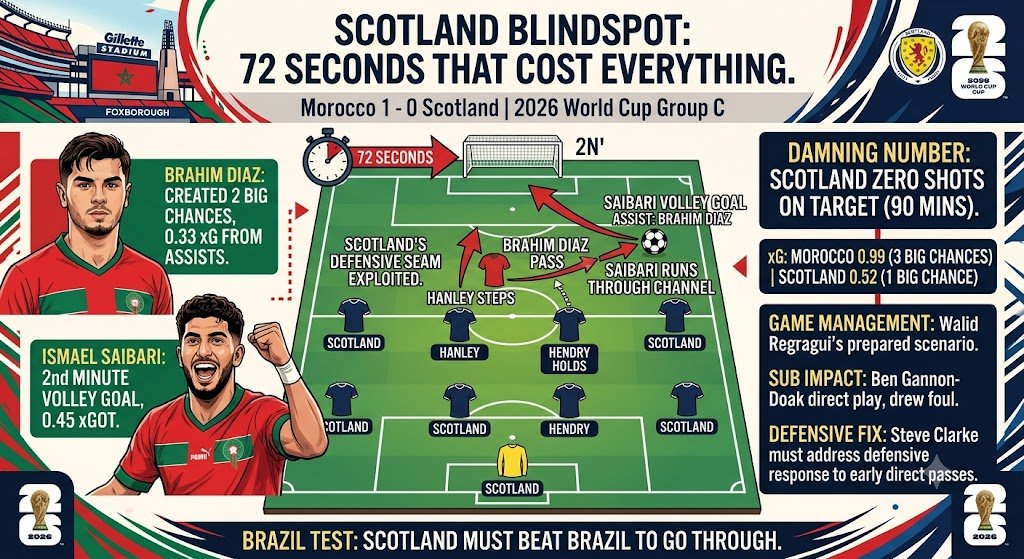
Brahim Diaz Found the Channel Scotland Left Open After 72 Seconds at the 2026 World Cup
Scotland did not register a single shot on target. In 90 minutes of a World Cup match against a side that had only one goal in its previous game, that is a damning number. Morocco beat Scotland 1-0 at Gillette Stadium in Foxborough on June 20, 2026, in their Group C match at the 2026 World Cup. Ismael Saibari volleyed home from 17 yards in the 2nd minute, assisted by Brahim Diaz’s through ball in behind Scotland’s defensive line, and that goal was enough. Morocco finished with 0.99 xG and three big chances created. Scotland ended the game with 0.52 xG, one big chance, zero shots on target, and a place in the history books they would rather not occupy.
For all the talk about Morocco’s quality in possession, which was real, the goal came from a decision Scotland’s defenders made in the opening 90 seconds that they had no chance to undo for the remaining 88 minutes.
Grant Hanley stepped forward to press Saibari as the ball travelled over the top from Brahim Diaz’s position just inside the Moroccan half. Hanley’s instinct was correct in principle press the runner, deny the turn but the pass was already ahead of him and Saibari had a yard of pace on Hanley before the Scotland captain had fully committed. Jack Hendry, Scotland’s other central defender, held his line rather than following. The result was a seam between them that Saibari ran clean through, and by the time he reached the ball near the right side of the box, the angle and the bounce allowed him to volley across Angus Gunn at 0.45 xGOT almost a coin-flip chance of going in, and he took it.
Steve Clarke’s 4-4-1-1 was built around keeping Morocco’s wide players,
particularly Achraf Hakimi, from crossing dangerously. Hakimi had 108 touches and 0.32 xG from two shot attempts, both from distance. That element of the plan mostly worked. What did not work was Scotland’s ability to maintain a compact, coordinated defensive line when Morocco switched the ball quickly from their own half and looked to play early. The 4-4-1-1, where Che Adams sat just behind Scott McTominay in a second-striker role rather than playing alongside another forward, was designed to give Scotland a pressing trigger in midfield a player who could close Morocco’s double pivot before they had time to build. Adams managed 11 touches. McTominay managed 51, but was largely deployed defensively.
Morocco’s 4-2-3-1 was in its element here. Azzedine Ounahi and Neil El Aynaoui the double pivot sitting between the back four and the three attacking midfielders gave the ball to Brahim Diaz early and consistently. Brahim Diaz’s role was to receive between Scotland’s lines and deliver quickly before the defensive shape could reorganise. He created two big chances across 80 minutes on the pitch, both from that same central zone. The 0.33 xG from his assists value tells you his passes were arriving in high-quality positions, not just being recycled. El Khannouss and Saibari peeled off the defensive line repeatedly, and Scotland’s midfield four was not positioned closely enough to the back four to cut off those runs before they became dangerous.
Even so, Scotland had their moments in the second half.
Ben Gannon-Doak came on at the hour mark for the injured Kieran Tierney and immediately changed Scotland’s energy on the left. Buzzing and direct, he drove at Noussair Mazraoui repeatedly, drew a foul near the Moroccan box in the 74th minute, and looked more threatening with the ball than anyone who started. Lyndon Dykes, introduced at the 71st minute, headed wide from a corner in the 86th minute from seven yards a 0.14 xG chance that he should have done better with but at least forced Morocco to defend. McTominay had two attempts blocked in the 85th and 88th minutes, both from central positions, showing Scotland could at least get into the right areas. They just never tested Yassine Bounou, who finished the match having faced zero shots on target.
Morocco deserved this win. They controlled the match territory, created three big chances to Scotland’s one, and managed the game professionally when it suited them. The simmering atmosphere of Scotland pressing hard in the final 20 minutes without reward was the exact scenario Walid Regragui would have prepared for Morocco were never genuinely rattled.
For Clarke, the specific fix before the Brazil match is about the defensive line and its response to early direct passes. Hanley stepping up to press in the second minute was a decision that left space behind him. Clarke needs to install a clearer rule: when Morocco or Brazil play over the top early, the deeper central defender holds while the closer one steps. Both stepping, or neither stepping, leaves runners free. Against Brazil’s front three, that mistake will be punished even faster and more severely than it was here.
Scotland need to beat Brazil to go through. They have not had a shot on target in the last 90 minutes.
That is the problem. And no formation change fixes it if the ball never reaches the goalkeeper.