
Haiti’s High Line Gave Brazil’s Front Three Exactly What They Wanted at the 2026 World Cup
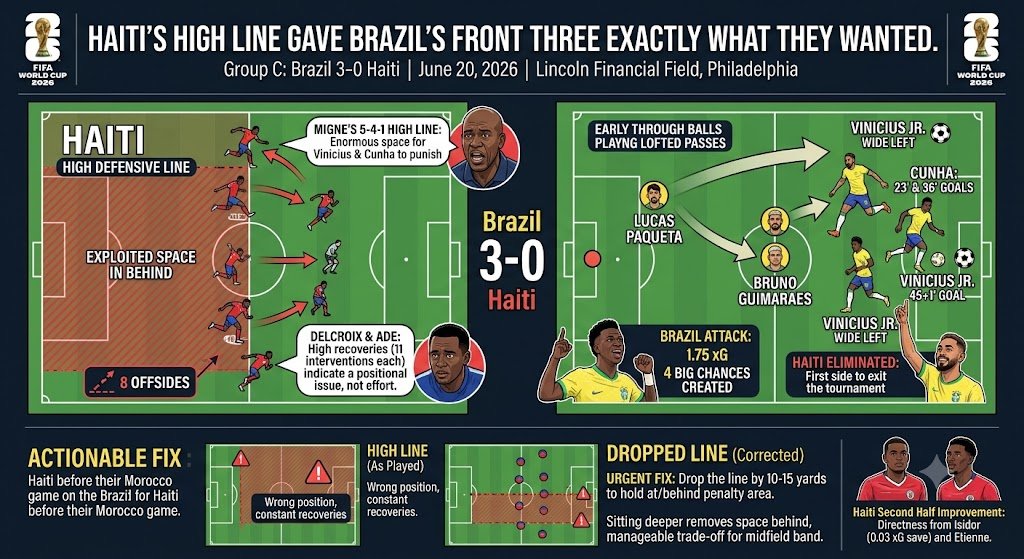
Eight offsides. That number tells you everything about how Haiti set up and everything about why it failed. Brazil beat Haiti 3-0 at Lincoln Financial Field in Philadelphia on June 20, 2026, in their Group C match at the 2026 World Cup, with Matheus Cunha scoring in the 23rd and 36th minutes and Vinicius Junior adding a third in first-half stoppage time. Brazil finished with 1.75 xG and four big chances created. Haiti ended the match with 0.23 xG, no big chances, and the distinction of becoming the first side eliminated from this tournament.
Raphinha had two separate runs in behind disallowed for offside before the opening goal even arrived. Brazil went ahead anyway in the 23rd minute through a fast break, Cunha finishing from eight yards after Vinicius drove into the area and forced a parry from Johny Placide. Cunha added his second in the 36th minute from 17 yards, firing high into the top left corner from a Vinicius through ball. Vinicius himself slotted the third in added time from Lucas Paqueta’s lofted pass in behind the defensive line.
All three goals came from the same structural problem in Haiti’s 5-4-1.
Haitian coach Marc Migne set his side up to defend deep with five defenders and a flat midfield four a shape that, in principle, should make it very difficult to play through centrally. The problem was the defensive line sat far too high. A 5-4-1 with a high line gives attacking players enormous space in behind the last three or four defenders, which is the exact type of space that Vinicius and Cunha punish most ruthlessly. Brazil’s 4-3-3 kept Vinicius wide left and used Bruno Guimaraes and Lucas Paqueta to play early through balls over and beyond that defensive line before Haiti’s wing-backs could tuck in and cover. The timing of those runs was a coaching decision, not an accident. Carlo Ancelotti’s team had clearly identified the space and rehearsed how to get into it.
The irony is that the 5-4-1 gave Haiti some theoretical protection. Hannes Delcroix had 11 defensive interventions and Ricardo Ade had 11, two of the highest totals across either team. Jean-Kevin Duverne and Martin Experience were constantly engaged. Haiti’s defenders were working constantly and working hard. The issue was not their effort. It was where the line was positioned, which kept dragging them into recoveries rather than preventing the problem from arriving in the first place.
Brazil were not especially good for the first 20 minutes.
Make no mistake, Ancelotti’s team started flat and unfocused, struggling to find consistent passing combinations in the final third against a side sitting in two disciplined banks. Seven through balls across the entire match suggests the attempts were there, but the first of them to actually produce a goal came as much from Vinicius forcing the issue individually as from a choreographed pattern. Once the opening goal arrived, however, Haiti’s defensive shape was forced to open. Pushing players forward meant the five-back line had to drop and the midfield four had to push up, which left seams between the lines that were not present before. Cunha’s second, a front-foot finish from a forward-running position, came precisely from that newly created space.
Raphinha’s injury at the 40th minute was a genuine concern. He departed with what appeared to be a hamstring problem, replaced by Bournemouth teenager Rayan. Ancelotti managed the situation carefully, withdrawing Cunha and Paqueta at the hour mark and introducing Endrick and Gabriel Martinelli, which kept the energy high without overextending players ahead of the Scotland match. Endrick had a goal correctly ruled out for offside in the 78th minute and Martinelli hit the crossbar moments later both removed from the final scoreline, but both suggesting the depth of Brazil’s forward options is considerable.
Haiti’s second half was better than the first in one specific area: their own forward movement. Wilson Isidor and Derrick Etienne, both introduced at half-time or shortly after, caused Alisson one genuine moment of alarm when Isidor drove from a tight angle in the 87th minute, forcing a low save at his near post. The xG on that shot was 0.03 not dangerous by the numbers, but the intent and directness were real. A Haitian team that came to the game with more forward ambition and a deeper defensive line might have kept this closer. They did not. But they were not entirely passive either.
For Migne, the specific fix before the Morocco game is clear and urgent: drop the defensive line by 10 to 15 yards and instruct the back five to hold a position level with or just behind the edge of the penalty area when defending. Sitting deeper removes the space in behind that Brazil, and potentially Morocco, will target repeatedly. The trade-off is more room between midfield and defence but Haiti’s midfield four is organised enough to manage a compact 15-yard band rather than sprinting back from a high line every time a through ball is played. Eight offsides conceded against Brazil suggests Haiti were generating that space constantly. Sitting deeper turns it into a manageable problem rather than an open invitation.