
Nagelsmann’s Triple Change Turned a Losing Germany Around at the 2026 World Cup
Five goal contributions in 56 minutes of World Cup football. Deniz Undav had not started either of Germany’s first two matches in Toronto, and by the 94th minute he had scored twice to win one of them. That number belongs in a conversation about the most influential substitutions this tournament has seen and it says something uncomfortable about Julian Nagelsmann’s starting selections.
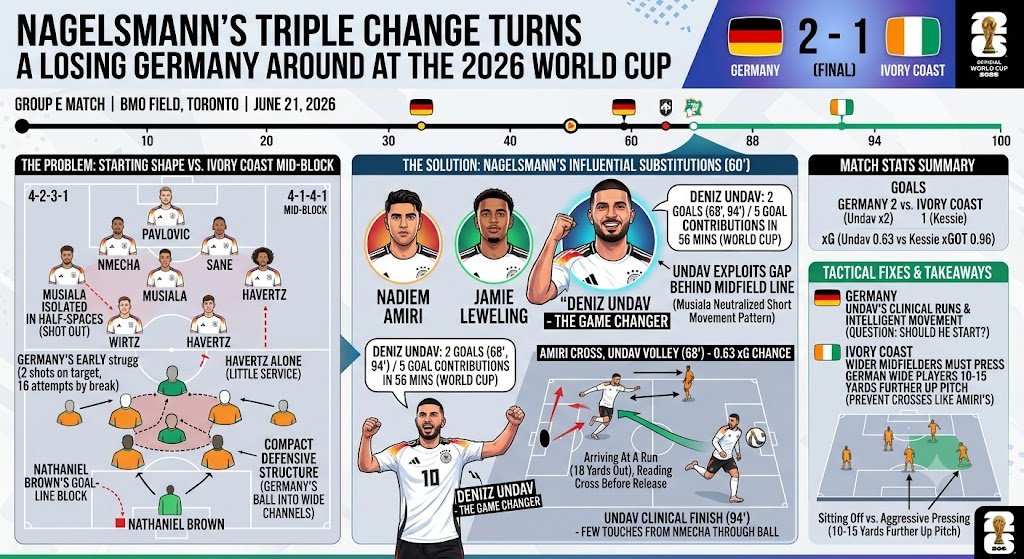
Germany beat Ivory Coast 2-1 at BMO Field in Toronto on June 21, 2026, in their Group E match at the 2026 World Cup. Franck Kessie put Ivory Coast ahead in the 30th minute from nine yards after Amad Diallo’s shot was blocked on the line by Nathaniel Brown. Undav levelled in the 68th minute with a controlled volley from six yards, assisted by fellow substitute Nadiem Amiri’s cross, then fired home from 16 yards in the 94th minute from Felix Nmecha’s through ball to seal a 2-1 win. Germany are through to the round of 32 with a perfect six points from two games.
Nagelsmann set his side up in a 4-2-3-1 with Kai Havertz as the lone forward, Jamal Musiala in the number ten role, and Florian Wirtz and Leroy Sane flanking him in the three. Aleksandar Pavlovic and Nmecha sat as the double pivot the two holding midfielders whose job is to win the ball back and distribute it forward quickly. On paper it was an attacking shape. In practice, for the first hour, it did not work.
The problem was Ivory Coast’s 4-1-4-1.
Emerse Fae set up a narrow mid-block four midfielders compressed centrally, a single striker pressing high that forced Germany’s ball into wider channels where it was less dangerous. Havertz received very little in the central areas where he is most effective, finishing with three shots and 0.21 xG from 45 touches. Musiala, who had been so sharp against Curacao, was shut out almost entirely by Ivory Coast’s midfield line sitting close together and denying him the half-spaces the pockets of ground between a defender and a midfielder he needs to operate. By the break, Germany had just two shots on target from 16 attempts. They had 60% possession and were heading toward half-time level, but only because Nathaniel Brown had blocked a certain goal on the line in the 30th minute, and because Pavlovic and Musiala had two efforts correctly ruled out for fouls.
Kessie’s goal came from a sequence that exposed exactly how Germany’s press can break down. Yan Diomande drove at pace down Ivory Coast’s left channel and pulled a low cross back into the area. Brown got enough of Diallo’s first-time shot to push it wide, but Kessie, arriving late to the penalty spot, fired into the bottom corner from nine yards. The 0.96 xGOT the expected goals on target value, measuring how likely a shot on target is to go in confirms that was almost certainly a goal from the moment it left his boot. Germany’s back four had tracked the initial run but did not pick up the second wave of arrivals.
At half-time, with Nico Schlotterbeck already substituted off with an injury, Nagelsmann began constructing the shape change that would eventually win the match. Bringing Antonio Rudiger into the back four gave Germany more authority defending set pieces and allowed Tah to concentrate on the central defensive role rather than covering. Then, on the hour, three substitutions at once: Amiri for Pavlovic, Leweling for Sane, and Undav for Musiala.
That last one is the decision that will define this match tactically.
Musiala drops deep to receive between the lines and probe. Undav runs in behind. Those are very different demands, and Ivory Coast’s midfield block was structured specifically to neutralise Musiala’s movement pattern tracking him short, never giving him space to turn. Undav exploited the gap behind that same midfield line within eight minutes of coming on. Amiri, given too much room on the right, curled a delivery to the back post. Havertz jumped but missed it. Undav, arriving at a run from 18 yards out, had read the cross before Amiri had released it, and volleyed from six yards into the high centre of the goal. The xG for that chance was 0.63. A clinical finish but first and foremost an intelligent run that the starting line-up had not been making.
Ivory Coast’s response was energetic but disorganised. Three substitutions at once at the 75-minute mark Adingra for Diallo, Seko Fofana for Sangare, and Guessand for Bonny changed the personnel without changing the structure. Diomande, who had been outstanding all evening with 10 defensive interventions and a constant threat in behind Germany’s full-backs, was withdrawn in the 85th minute for Nicolas Pepe. With Diomande gone, Ivory Coast lost their most dangerous channel runner. Two minutes into stoppage time, Nmecha played a sharp through ball between the Ivory Coast centre-backs, Undav took one touch to turn and fired low to the bottom left. Germany had won a match they were losing an hour earlier, with a striker who had not started.
For Fae, the concrete fix before the final group match is specific. Ivory Coast allowed Amiri too much time on the right of Germany’s midfield after the hour mark the cross that led to the equaliser came from a position that a compact defensive structure should never permit. Fae must ensure his wide midfielders press the German full-backs and wide players more aggressively when they receive facing forward. Sitting off and retreating invites exactly the kind of delivery Amiri produced. Sharper pressure 10 to 15 yards further up the pitch kills those deliveries before they arrive.
Nagelsmann got more from his bench than his starting eleven. That is a perfectly fine way to win a football match at a World Cup.
Still, at some point, the question of whether Undav should be starting has to be answered and the only person who has to answer it is Nagelsmann himself.