
Paraguay’s 4-4-2 Block Outlasted Turkey’s 2.17 xG at the 2026 World Cup
32 shots. 2.17 xG. Five on target from a side that had a man advantage for nearly the entire second half. Turkiye generated all of that and still could not score. Paraguay’s 1-0 win over Turkiye at Levi’s Stadium in Santa Clara on June 20, 2026, in their Group D match at the 2026 World Cup is not the story of a team holding on for dear life. It is the story of a defensive structure that was almost impossible to break down, a red card that should have ended Paraguay’s night early, and a Turkish attack that kept finding different ways to hit the same wall.
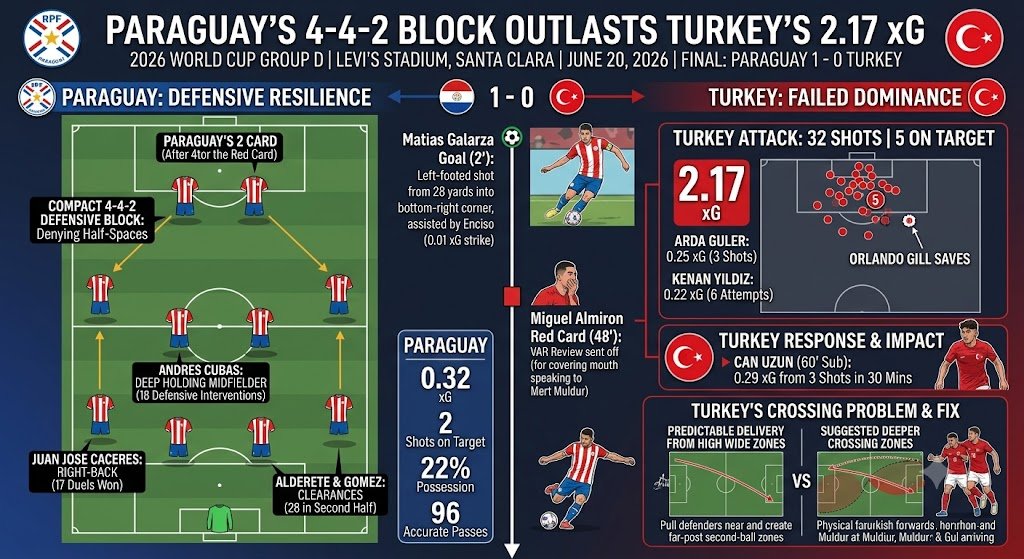
Matias Galarza scored after 65 seconds, firing left-footed from 28 yards into the bottom-right corner from a pass by Julio Enciso. Miguel Almiron was then sent off in the 48th minute of first-half stoppage time after a VAR review for covering his mouth while speaking to Mert Muldur. Turkiye finished with 2.17 xG and five shots on target from 32 attempts. Paraguay ended it with 0.32 xG, two shots on target, and their place in the knockout race alive.
Daniel Garnero set Paraguay up in a 4-4-2 a flat four-man midfield and two forwards which is a shape built for compactness rather than possession. With 22% of the ball and just 96 accurate passes all game, Paraguay were never going to control territory. They were not trying to. The 4-4-2 sat in two banks of four, with the midfield line and defensive line positioned closely together to deny Turkiye the half-spaces the pockets between wide defender and centre-back where Arda Guler and Kenan Yildiz do their best work. Both players had reasonable individual statistics: Guler finished with 0.25 xG across three shots, Yildiz with 0.22 xG and six attempts. Neither found a lane that lasted more than a second before a red or white shirt closed it down.
Truth is, the red card made Turkiye worse, not better.
Losing Almiron shrank Paraguay’s options but concentrated their focus. Before the dismissal, they had briefly threatened on the break; Enciso in particular was a nuisance when carrying the ball forward. After it, Paraguay became purely a defensive unit, and that clarity of purpose was almost liberating. Andres Cubas dropped into a holding position the midfielder who sits between the defence and the rest of the team to protect the back four and completed 18 defensive interventions, the highest of any player on either side. Juan Jose Caceres was brilliant at right-back, winning 17 duels. Omar Alderete and Gustavo Gomez cleared 28 balls between them in the second half alone.
Turkiye’s 4-2-3-1 was structurally fine for attacking an open opponent. Against a team in deep blocks, with barely any space behind the line, it gave the front four too little to work with centrally. Vincenzo Montella responded at half-time by withdrawing Kerem Aktürkoglu and sending on Baris Alper Yilmaz on the right, then at the hour mark replaced Yunus Akgun and Ismail Yuksek with Deniz Gul and Can Uzun adding a more physical presence in the box and a runner from deep. Between the 75th and 90th minutes, Muldur had three separate headed chances from crosses and missed all of them. The delivery was good. The execution was not.
One number explains this game more than any other: of Turkiye’s 32 shots, just five were on target. The xG on those five shots came to 0.67, which means the average quality was fine about 0.13 per on-target attempt. Turkiye were not shooting from ridiculous angles. They were generating real chances and then either hitting a defender, firing wide, or finding Orlando Gill at full stretch. Gill made five saves, including a brilliant stop from Uzun’s low drive at 89 minutes that preserved the win when the match had felt the most electric and frantic.
The Uzun situation deserves more attention than it has received. He came on at the 60th minute and immediately looked dangerous quick, direct, willing to drive at defenders. His 0.29 xG from three shots in 30 minutes off the bench was the closest any individual Turkish player came to genuinely threatening the goal in the second half. Montella would have been better served bringing him on at half-time rather than the 60th minute, sacrificing one of the midfield slots and pushing Guler into a deeper creative role to free up more space in the final third. By the time Uzun had hit top speed, the game was already simmering toward its frantic conclusion rather than building toward it.
For Montella, the one concrete and actionable change before his third group match though it comes too late to save Turkiye’s 2026 campaign would be to address how his side responds when the central channels are closed. Turkiye sent 50 touches into the opposition box but created only four big chances and missed all five of them. The problem was the delivery point: most crosses and cut-backs arrived from positions where Paraguay’s defenders were already in line with the ball. Montella needs his wide players arriving later and deeper into the crossing zone, pulling defenders toward the near post and creating a second-ball zone at the far post where Muldur, Gul, and Demiral all effective aerial threats can arrive without being marked. Every ball from the same position gets the same defensive answer. Change the angle of delivery.
Turkiye created enough to win this match three times over.
Paraguay won it in the second minute, then survived everything that followed. That is a different kind of performance. And it should not be underestimated.