
Koeman’s 4-3-3 Exposed Sweden’s Back Three Down Both Flanks at the 2026 World Cup
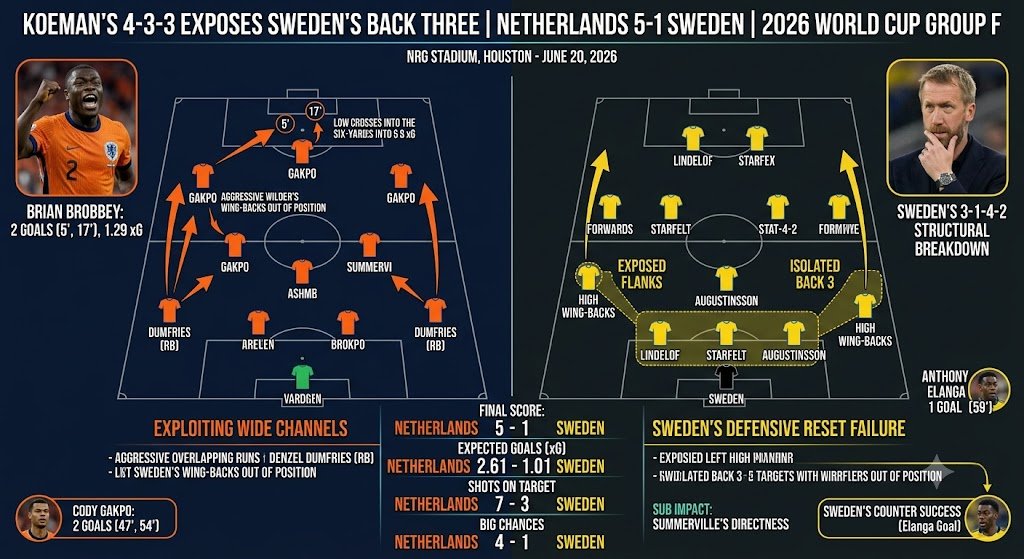
Two goals inside 17 minutes. Both from low crosses into the six-yard box. Both prodded home by the same striker. Before Sweden had worked out what was hitting them, the match at NRG Stadium in Houston was already shaped. Netherlands beat Sweden 5-1 on June 20, 2026, at NRG Stadium in Houston in their Group F match at the 2026 World Cup, with Brian Brobbey scoring twice in the 5th and 17th minutes, Cody Gakpo adding two more in the 47th and 54th, and Crysencio Summerville completing the rout in the 89th. Anthony Elanga pulled one back for Graham Potter’s side in the 59th minute. Netherlands finished with 2.61 xG against Sweden’s 1.01.
Strip away the noise and the reason this happened so quickly is structural. Ronald Koeman’s 4-3-3 sent Denzel Dumfries bombing forward on the right and the left channel equally busy, while Sweden’s 3-1-4-2 left its wide wing-backs dangerously exposed every time the Netherlands moved the ball quickly from one side to the other. Both Brobbey goals came from crosses delivered before Sweden’s defensive shape had time to reset. Tijjani Reijnders swept the first ball left to Gakpo, who pulled it low across the face of goal in the 5th minute for Brobbey to tap in from six yards. Twelve minutes later, Dumfries delivered a mirror image from the right, and Brobbey prodded home again from five yards. Same pattern. Same zone. Same outcome.
Sweden’s 3-1-4-2 is built for solidity through the middle. Three centre-backs plus a defensive midfielder Jesper Karlstrom sitting in front of them as the single pivot, the player whose job is to screen the back line gives Emerse Fae’s side real strength against teams that try to play through the centre. Netherlands did not try to play through the centre. Gakpo and Malen occupied the wide areas from the first minute, pulling Sweden’s wing-backs high and leaving the central three with nobody to press. Dumfries had 57 touches and two assists by the time he was done. He was given space that a full-back at a World Cup should never receive.
Brobbey’s selection ahead of Summerville raised eyebrows before kick-off. The tactical reason became obvious within five minutes. Brobbey holds the ball up, drags centre-backs into contact, and arrives late into crossing zones without being tracked. Viktor Gyokeres is a different kind of forward he makes runs in behind, which is useful against high defensive lines. Against a deep-sitting back three, Brobbey’s movement between defenders was the correct call. He finished with 1.29 xG from two chances, both of which he converted cleanly.
Koeman made one change at half-time, withdrawing Donyell Malen and introducing Summerville on the left. Sweden’s 3-1-4-2 was already broken by that point, but Summerville’s directness and willingness to run at Victor Lindelof rather than play short passes into congested zones made the second half even more one-sided. She assisted Gakpo’s third goal in the 47th minute with a low cross that Brobbey just failed to reach at the back post, leaving Gakpo to tap home from three yards a 0.95 xG chance that was essentially a formality. Seven minutes later, Sweden turned the ball over midfield and Summerville drove forward, feeding Gakpo to cut in from the left and fire into the bottom corner.
Sweden’s one clear tactical success during the match was the counter in the 59th minute. Elanga’s goal was a reminder of what the 3-1-4-2 can produce in transition Isak received centrally, played through ball into space behind Micky van de Ven, and Elanga ran onto it and clipped past Bart Verbruggen from 18 yards. The 0.65 xGOT value tells you it was a well-struck, well-placed effort. For a brief period after that goal Sweden looked genuinely dangerous on the break, and Elanga beat Van de Ven consistently down the right. Potter would do well to remember that shape when his side need a goal against Japan.
The substitutions Sweden made at the 55-minute mark Elanga for Bernhardsson, Zeneli for Karlstrom, Bergvall for Nygren changed the energy but not the structure. Removing Karlstrom, the defensive pivot, in a match where his team were 4-0 down was a concession that the game was over as a contest. Bergvall and Zeneli had more forward intent, but with the match already gone they were running into space Netherlands were not particularly concerned about defending.
Yasin Ayari was one player who kept going when others around him stopped. He had five shots on goal across the 90 minutes the most by any Sweden player and carried the ball forward repeatedly from midfield when his teammates had run out of ideas. That is worth acknowledging. A 5-1 defeat can obscure individual performances that were considerably better than the scoreline suggests.
For Potter, the specific fix before the Japan game is about how Sweden defend wide deliveries into central areas the exact source of the first two goals. His three centre-backs need to identify the moment a cross is incoming and decide immediately who tracks the runner arriving from deep. Neither of Brobbey’s goals involved a difficult cross. What they involved was Brobbey arriving untracked from 10 yards behind the play. Potter must assign one of his three central defenders the sole responsibility of picking up the late runner into the six-yard box, regardless of where the ball is. At the moment that block shifts when all three defenders concentrate on the ball rather than the arrival that is exactly where Netherlands scored.
Sweden generated the better goal difference going into this group stage. They leave it with that advantage completely gone and facing a match against Japan they now need to win.