
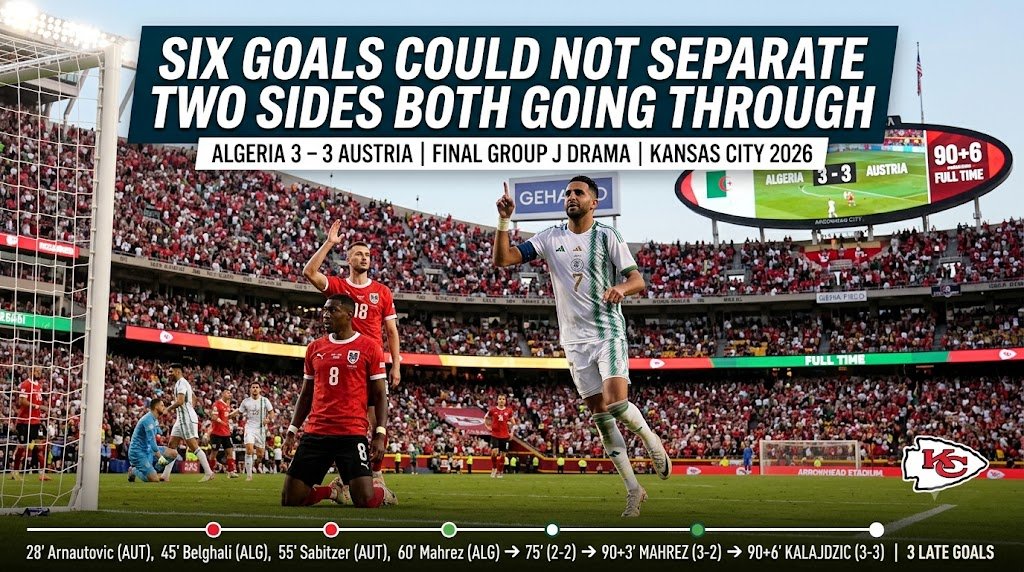
Six Goals Could Not Separate Two Sides Both Going Through
Three goals arrived in the last fifteen minutes of this game, more than any other side has managed in that window at this World Cup. That single number tells you what kind of match Algeria and Austria just played, and it is the right place to start.
Algeria drew 3-3 with Austria at GEHA Field at Arrowhead Stadium in Kansas City on June 28, 2026, in their final Group J match at the World Cup. Both sides finish on four points and advance to the round of 32, while the result eliminates Iran, who needed one of these teams to win to stay alive as a third-place qualifier.
Here are the basics for anyone catching up. Algeria 3, Austria 3. Marko Arnautovic scored for Austria in the 28th minute, Rafik Belghali leveled right on half-time, Marcel Sabitzer put Austria back in front in the 55th, Riyad Mahrez equalized in the 60th and then won it in the 90th plus 3rd, only for Sasa Kalajdzic to head a stoppage-time leveler three minutes later. Austria finish second in Group J behind Argentina and face Spain next. Algeria finish third and play Switzerland, coached by their former boss Vladimir Petkovic.
Both teams lined up in a 4-2-3-1, and the match turned on what each side did with that identical shape rather than any tactical surprise.
Algeria’s version asked Mahrez to drift inside from the right as a second striker alongside Amine Gouiri, while Houssem Aouar floated from left to center looking for the gaps that opened. That movement is exactly how both of Mahrez’s goals came. For the equalizer in the 60th, Aouar drew two Austrian midfielders toward the ball before slipping it through to Mahrez in space that should not have existed in a back four. The stoppage-time winner followed the same script almost exactly.
Here is the thing about Austria’s system. It looked identical on paper but worked completely differently in practice.
David Alaba dropped deep from center-back to start attacks with long, direct passes rather than building through midfield, and Arnautovic’s opener came directly from that pattern. He chased down a dropping ball from Alaba and beat Oussama Benbot before Algeria’s defense had organized. It was a route-one goal dressed up as a possession move, and it worked because Algeria were not expecting directness from a back line.
The numbers back up how even this really was. Algeria finished with 1.67 expected goals to Austria’s 1.49, both sides comfortably beating their own totals with the finishing on show. Make no mistake, neither defense was particularly organized. Algeria’s back three of Ramy Bensebaini, Aissa Mandi and Belghali were repeatedly dragged out of position by Austria’s front three rotating positions, while Austria’s makeshift back line struggled with Aouar finding pockets between the lines all night.
Substitutions decided both late goals, and not by accident.
Petkovic’s choice to bring on Aouar’s replacement was forced by fatigue rather than tactics, but Austria’s coach Ralf Rangnick made the change that mattered. Bringing on the towering Kalajdzic for left-back Phillipp Mwene in the 90th plus 5th minute was a pure aerial gamble, sacrificing defensive solidity entirely. It paid off within ninety seconds when Michael Gregoritsch, himself a halftime substitute, delivered the cross that Kalajdzic headed home.
One thing Austria did well all match deserves real credit. Their pressing in transition forced Algeria into long balls for long stretches, and Algeria’s 94 percent pass accuracy mostly came in low-risk zones rather than dangerous ones, suggesting the territory was less one-sided than the possession numbers suggest.
Strip away the noise and the coach who got more right here is Rangnick. Down 2-1 with ten minutes left against a team controlling the ball, he had the conviction to remove a fit defender for a six-foot-seven striker purely to win the next cross. That is not the safe choice. It is the correct one when your team needs a goal and has nothing to lose by chasing it.
For Petkovic, the fix is specific and it is not about effort. Algeria conceded their stoppage-time equalizer because both full-backs pushed forward to chase a winning goal with no cover behind them, leaving Kalajdzic isolated against Mandi in the air with no second defender arriving on the cross. A team leading in the final minutes needs one extra body dropping into the box on any Austrian set piece or cross, full stop.
Both sides walked away with what they needed. Neither walked away convinced they should have needed stoppage time to get it.