
Room and the 5-4-1 That Broke Ecuador’s 3-1-4-2 at the 2026 World Cup
Fifteen saves. In 90 minutes. At a World Cup. Let that number do the work for a moment before anything else is said.
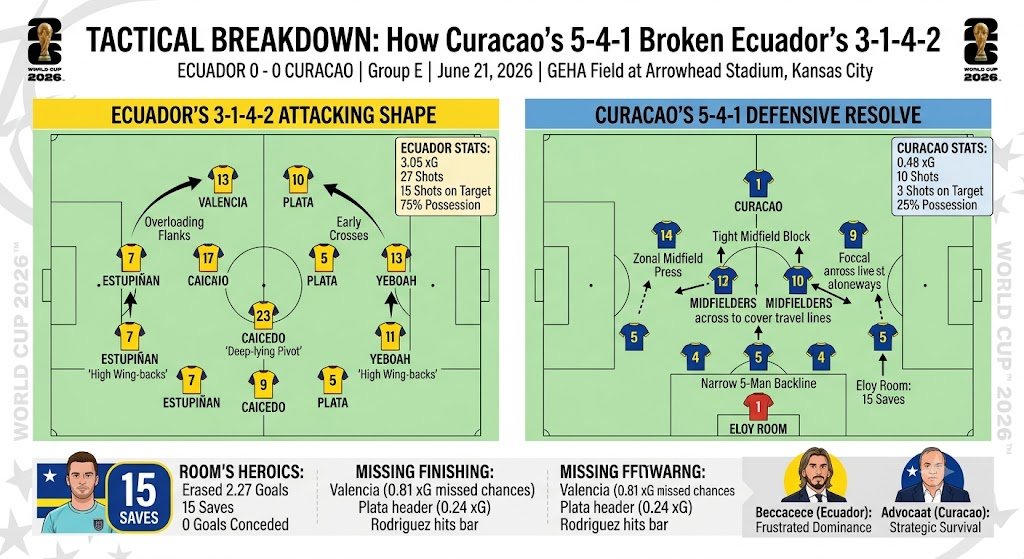
Ecuador drew 0-0 with Curacao at GEHA Field at Arrowhead Stadium in Kansas City on June 21, 2026, in their Group E match at the 2026 World Cup. On paper, that sentence looks like a neutral fact. In reality, it describes one of the most tactically lopsided scorelines in tournament history a match where one side generated 3.05 xG, created four big chances, put 15 shots on target from 27 attempts and held 75% of the ball, and the other side produced 0.48 xG, zero big chances, and three shots on target from ten. Ecuador did everything except score. Curacao did almost nothing except survive. And Dick Advocaat’s 5-4-1 was the reason why.
Ecuador left Kansas City with one point from two matches and a creeping sense that something has gone wrong with this team’s ability to convert dominance into goals.
Sebastian Beccacece set his side up in a 3-1-4-2, using Moises Caicedo as the deep-lying pivot the holding midfielder who sits between the back three and the midfield four, recycling possession and dictating tempo. With Enner Valencia and Gonzalo Plata ahead of him, the shape was designed to overload Curacao’s wider zones and deliver early crosses into a crowded box. For long stretches, it worked exactly as planned. Ecuador’s wing-backs pushed high, Pervis Estupinan and John Yeboah stretching the pitch, and the crossfield switches from Caicedo found space regularly.
Here’s the thing Curacao’s 5-4-1 was not passive. It was precise.
Advocaat set five defenders across a narrow back line and instructed his four midfielders to press only in specific zones, retreating quickly to form a tight block between the 18-yard box and the halfway line. The width Ecuador found on the outside was real. The space inside the block was not. Every time Plata or Valencia received a pass facing the goal, a Curacao midfielder was already stepping across to cover the line of travel. It forced Ecuador sideways, backward, and into the kind of long-range speculative shooting that inflated their xG total without genuinely testing Room from dangerous positions. Of Ecuador’s 27 attempts, six came from outside the box. Several more came from angles that flattered to deceive.
Still, the sheer volume of quality chances was extraordinary.
Valencia had two chances in the opening 20 minutes that combined for 0.81 xG. A right-footed effort from 13 yards in the third minute carrying 0.49 xG drew an immediate stop from Room low to his right. Seventeen minutes later, Valencia was inside nine yards with the goal open, a 0.32 xG chance that the Curacao keeper again got down to well. By half-time, Ecuador had already generated more expected goals than most sides manage across an entire match in this tournament, and Room had personally erased every penny of it.
Beccacece made one substitution at the break, withdrawing Jordy Alcivar for Kevin Rodriguez, shifting the 3-1-4-2 into something closer to a 3-1-3-3 with more runners beyond the last line. The decision was understandable in theory. In practice, it led to the most frantic 25-minute spell of the match and still no goal. Between the 59th and 67th minutes, Ecuador had seven shots in rapid succession. Plata headed over from six yards with 0.24 xG. Piero Hincapie could not keep his header down from seven yards. Rodriguez hit the crossbar. Valencia, from four yards four yards was denied by Room’s outstretched hand on what should have been a certain goal.
Those eight minutes are the entire story of this match.
Curacao’s tactical contribution during the second half was to become increasingly cynical, and it worked. Juninho Bacuna was booked in the 53rd minute, Livano Comenencia in the 56th, and Jurien Gaari in the 75th, slowing play repeatedly at moments when Ecuador had built up pressure. That is not a coincidence. Advocaat knew his side could not contain Ecuador cleanly and instructed them to break the game up. Three yellow cards in 22 minutes is not bad discipline. It is a plan.
Tahith Chong the former Manchester United midfielder who has found renewed purpose under Advocaat was asked to track Moises Caicedo whenever Ecuador looked to play through the middle. He barely had a meaningful touch in the final third, but his off-ball work was continuous, harrying and pressing high enough to force Caicedo into longer passes that bypassed the attack and required recycling. Curacao’s own offensive moments were limited to Juninho Bacuna driving from deep and his brother Leandro Bacuna managing occasional bursts forward from his midfield slot. A triple chance at the hour mark Leandro Bacuna, Comenencia, and Jurgen Locadia all denied in one sequence by Hernan Galindez and Moises Caicedo was the fullest expression of what Advocaat hoped his team could produce on the counter. It was not much, but it was real.
For Beccacece, the fix before the Germany match is specific and urgent. Ecuador must stop entering the final third in a straight line. Time and again, their most dangerous moments came from diagonal runs Rodriguez and Plata arriving from wide at pace, meeting crosses from the opposite flank. When they played into feet in central areas, Room had the angles covered and the block was set. Beccacece needs his forwards moving before the ball arrives, pulling Curacao’s back five across, creating seams in the zone behind the midfield line. Against a Germany defense that has already conceded, those seams will be larger. The problem is that the same pattern that failed today could fail again if the movement is not timed differently.
Room saved his side 2.27 goals on target. He faces 15 shots on goal and concedes none. He does it in 90 minutes, not 120. Tim Howard needed extra time to match that record in 2014. Room did it against a side that created four genuine big chances and had 43 touches inside the opposition box.
Curacao leaves Kansas City with one point and the longest odds in Group E. They almost certainly need to beat Ivory Coast to advance. Advocaat will know that what worked against Ecuadora low block, disciplined pressing zones, and one miracle goalkeeper will not be enough against a side with more pace in behind.
But Ecuador’s coach leaves with the more pressing question: how does a team create 3.05 xG and score zero? Not once. Twice in two games, this team has generated the numbers and walked away empty. That is not Room’s genius. That is a finishing problem that tactics cannot entirely explain.