
South Africa’s Low Block Nearly Worked Until It Completely Didn’t
Zero. That is how many big chances South Africa created across 92 minutes at SoFi Stadium, and that number tells you everything about both the plan Hugo Broos set and why it eventually collapsed.
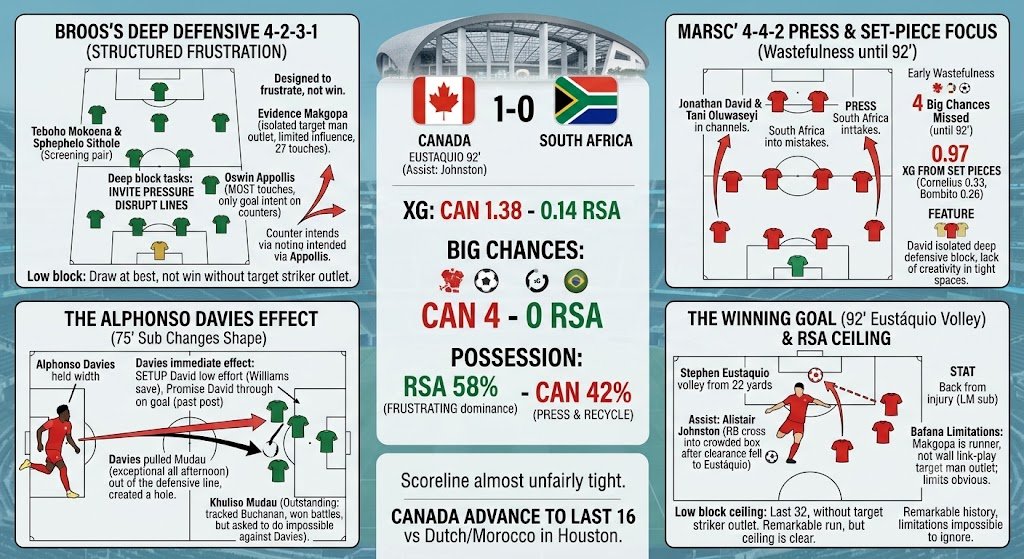
Canada beat South Africa 1-0 in the 2026 World Cup round of 32 at SoFi Stadium in Inglewood, California on June 29, with Stephen Eustaquio volleying home from 22 yards in the 92nd minute to send the co-hosts through to the last 16. South Africa finished with an xG of 0.14. Canada finished with 1.38. The scoreline, in the end, was almost unfairly tight.
Eustaquio scored, Alistair Johnston provided the cross, and 69,237 people inside the stadium the majority of them backing the co-hosts finally had something to roar about. Canada advance to face the Netherlands or Morocco in Houston on July 4. South Africa go home having reached the knockout rounds for the first time in their history, which was remarkable until Sunday, when their limitations became impossible to ignore.
Here is the tactical story of how that played out.
Broos built a 4-2-3-1 designed to frustrate, not to win
Strip away the noise and South Africa’s approach was not really a 4-2-3-1 in any attacking sense. It was a deep defensive structure with Teboho Mokoena and Sphephelo Sithole sitting in front of the back four, tasked with cutting off Canada’s passing lines and inviting pressure. Possession was not the aim disruption was. They finished with 58% of the ball without ever using it to threaten. That is a strange kind of dominance.
The idea was simple: sit compact, force Canada wide, and look to break on the counter through Oswin Appollis, who was easily South Africa’s most dangerous player all day. Appollis had 47 touches, more than any outfield player in a South African shirt, and was the only one who showed any genuine intent to drive at the Canadian defense. His two second-half efforts both from outside the box, both saved by Maxime Crepeau were the only moments where Bafana Bafana looked capable of scoring.
The problem with building a plan around Appollis was that it required the rest of the team to actually get him the ball in threatening positions. Evidence Makgopa, the striker deployed as the focal point, had 27 touches total across the first 86 minutes before being withdrawn. Seventeen of Appollis’s touches came in the first half but produced nothing meaningful because the delivery ahead of him was too slow and too predictable. Canada’s press, organised in a 4-4-2 mid-block, simply did not need to work very hard.
Canada’s 4-4-2 was built to exploit set-pieces and nearly paid off far earlier
Jesse Marsch set up with a clear plan of his own: press South Africa into mistakes in their own half, then recycle quickly through Eustaquio in the left midfield position to find Jonathan David and Tani Oluwaseyi in the channels. For the first 45 minutes, that plan worked well enough to generate 0.97 xG from set pieces alone. Bombito’s blocked header at the near post in the 44th minute had a 0.26 xG value. Cornelius’s effort shortly before that was worth 0.33 xG. Buchanan forced a save at point-blank range.
Canada created four big chances in total. They converted none of them until the 92nd minute. That wastefulness in front of goal kept South Africa in a match they had no realistic plan to win.
The 4-4-2 shape also exposed one of Canada’s persistent problems from the group stage a lack of creativity in tight spaces when opponents defend deep and deny the forward pass. David had only 22 touches in the first 62 minutes, and just six of those came inside the South African box. For a player who had scored a hat-trick against Qatar in the group phase, that kind of isolation was a tactical problem, not a finishing problem. Marsch addressed it, eventually, but he left it late.
The substitution that changed the shape
Alphonso Davies came on in the 75th minute for Buchanan, and the effect was immediate. Davies held his width on the left flank, which pulled Khuliso Mudau South Africa’s right-back, who had been exceptional all afternoon further and further from the defensive block. Within two minutes of coming on, Davies had drawn two defenders onto him and fed Jonathan David for a low, powerful effort that Williams beat away at his near post. A minute later, Davies played Promise David through on goal the same player who had scored against Switzerland and the substitute dragged his shot narrowly past the right post.
South Africa’s defensive shape, which had been disciplined and organised for 74 minutes, suddenly had a hole in it. Mudau could not cover Davies and maintain his position in the defensive line at the same time. That was the crack Marsch had been looking for.
Make no mistake, Davies arriving in the 75th minute rather than the 60th was a gamble that nearly backfired. South Africa managed to hold firm long enough after that initial Davies-inspired burst for the game to drift back toward extra time. Canada went 15 minutes without a shot. The crowd went breathless with anxiety. Then Johnston found a yard of space on the right, crossed it into a crowded box, and the clearance fell to Eustaquio back from an injury delay in the 57th minute who chested it down and drove it into the bottom corner.
What South Africa did well and why it was never going to be enough
Mudau deserves particular mention. He was outstanding. All afternoon he tracked Davies’s runs, dealt with Buchanan’s crosses before they arrived, and won his individual battles more often than not. He finished with 79 touches, among the most of any defender on the pitch, which tells you how active he had to be to keep Canada’s right side quiet. When Davies finally arrived and stretched him beyond what one full-back can manage alone, it was not a failure of effort. It was simply one player being asked to do the impossible.
Broos also got one thing very right at half-time. He took off Relebohile Mofokeng, who had been anonymous, and brought on Thalente Mbatha to add more defensive cover in midfield. South Africa’s second half was noticeably more controlled than their first in terms of not conceding chances from open play. Between the 46th and 86th minute, Canada’s open play xG was just 0.40. The problem was that Mbatha’s introduction made South Africa even less of a threat going forward, which meant the entire plan rested on staying level long enough to take it to extra time.
They did not quite manage it.
The one concrete fix Broos needed and did not have
Truth is, the tactical problem South Africa faced was not entirely of Broos’s making. Their squad does not have a striker capable of holding the ball up under pressure and linking play when sitting deep and absorbing for long periods. Makgopa is a runner, not a wall. Rayners, who came on in the 86th minute, had barely enough time to influence anything. If Broos is going to use this system again at this level which he should not, because the quality gap against Canada was already significant, and the Netherlands or Morocco would have been worse he needs a target man who can give his team an outlet ball when the press closes in. Without that, his low block is a plan for a draw at best, not a plan to win.
South Africa’s World Cup is over. The dressing room, by all accounts, went completely silent after Eustaquio’s goal. That is the right reaction. They reached the last 32 for the first time. They did it without ever really looking like going further.
That is history, and it is also, honestly, a ceiling.