
Cape Verde Outplayed Saudi Arabia and Still Did Not Win 2026 World Cup Group H
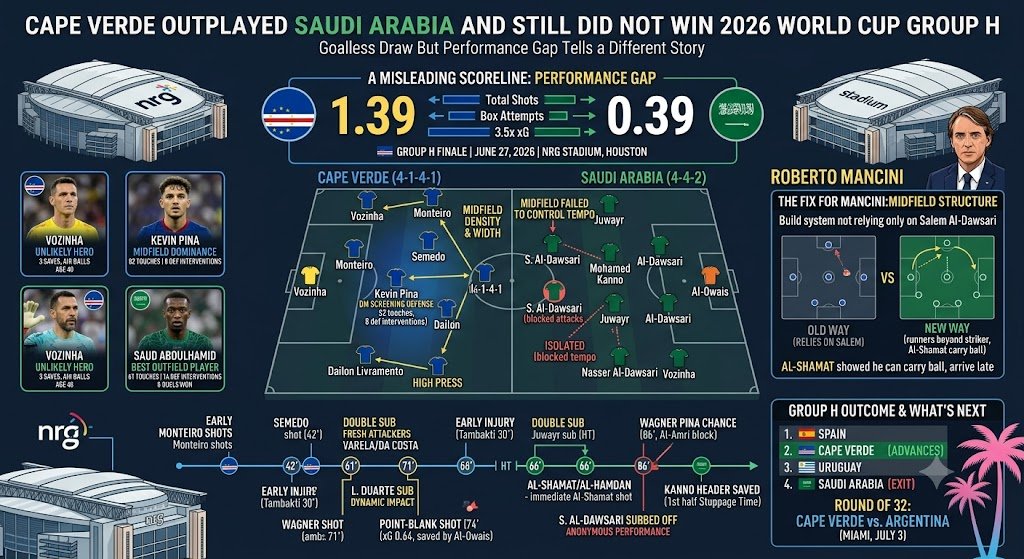
1.39 to 0.39. In a match that ended goalless, that xG gap expected goals, a measure of how likely each team’s chances were to go in tells you which side was genuinely the better team at NRG Stadium in Houston on June 27. Cape Verde drew 0-0 with Saudi Arabia in their 2026 World Cup Group H finale, a result that was enough to send the Blue Sharks through to the round of 32 as group runners-up behind Spain. Saudi Arabia finish bottom and go home.
Cape Verde advance to face Argentina in Miami on July 3. Saudi Arabia’s tournament is over. The scoreline was level. The performance absolutely was not.
The 0-0 framing is misleading on every level. Cape Verde had 15 shots to Saudi Arabia’s seven, nine of those attempts inside the box compared to Saudi Arabia’s five, and finished with more than three and a half times the xG of their opponents. A nation of just over 500,000 people, making their World Cup debut, dominated a side that reached the round of 16 four years ago. That is the real story of this group stage, and it is worth sitting with for a moment before moving on to the knockout round narrative.
How Bubista’s 4-1-4-1 worked and why Saudi Arabia could not cope with it
Cape Verde lined up in a 4-1-4-1, with Kevin Pina sitting as a single defensive midfielder a player positioned in front of the back four whose job is to screen the defense and recycle possession. Ahead of him, a narrow band of four midfielders gave the Blue Sharks both width and central density. The single striker, Dailon Livramento, pressed high to prevent Saudi Arabia from playing out easily from the back.
Saudi Arabia’s 4-4-2 was built on the assumption that their two central midfielders, Nasser Al-Dawsari and Mohamed Kanno, could control the tempo and feed Salem Al-Dawsari in the channels. That plan collapsed almost immediately. Cape Verde’s narrow midfield press meant Saudi Arabia could not find clean lines through the middle, while Kevin Pina’s 82 touches and eight defensive interventions effectively blocked the space where their two strikers wanted to receive. The Saudis finished with just five attempts inside the box all match. Three of those came from distance or were blocked at source.
Here is the thing Cape Verde were not just sitting deep and absorbing. They were actively creating. Jamiro Monteiro had two shots in the first half from central areas before being replaced at half-time. Willy Semedo tested Al-Owais from the left channel in the 42nd minute. By the time the second half started, the pattern was already clear: Saudi Arabia did not have the midfield quality to break through a well-organised five-man unit that pressed high and recovered quickly.
The substitutions that changed both shapes
Saudi Arabia made an injury-forced change at half-time, losing Hassan Al-Tambakti to injury as early as the 30th minute and replacing him with Ali Lajami, before bringing on Musab Al-Juwayr at the break for Abdullah Al-Khaibari. Al-Juwayr added pace on the left, which briefly unsettled Cape Verde’s right side, but the most significant Saudi changes came in the 66th minute when both Salem Al-Dawsari and Sultan Mandash were replaced by Mohammed Abu Al-Shamat and Abdullah Al-Hamdan.
Salem Al-Dawsari had been anonymous for much of the match 35 touches, one shot blocked, no clear-cut chances created. His removal told you everything about how Saudi Arabia’s attacking plan had fallen apart. Al-Shamat came on and forced a save from Vozinha within a minute of entering, testing the Cape Verde goalkeeper with a driven effort across goal. But by that point, Bubista had already made his own decisive moves.
Cape Verde’s double substitution in the 61st minute Helio Varela and Nuno da Costa replacing Semedo and Livramento was smart. Both fresh attackers were more direct in tight spaces than the players they replaced. Da Costa, in particular, had the assist that led to Laros Duarte’s 74th-minute shot a clear-cut chance, with xG of 0.64, meaning the model rated it as a better-than-even chance of going in that Al-Owais turned away at point-blank range. Then, at the 71st minute, Laros Duarte himself came on for Monteiro and immediately became the most dangerous player on the pitch.
Bubista left his best bench options until they were needed, staggered them well, and maintained the shape without losing the attacking threat. That is not a small thing at this level.
What Saudi Arabia did well and why it still was not enough
Make no mistake, Saudi Arabia were not completely passive. Abdulelah Al-Amri’s block to deny Wagner Pina in the 86th minute the Cape Verde right-back arriving late into the box unmarked was crucial and showed good defensive awareness. Saud Abdulhamid was their best outfield player across the 90 minutes, finishing with 61 touches, 14 defensive interventions, and eight duels won. He won more individual battles than anyone else on the Saudi side and kept his discipline when the pressure mounted late on.
Kanno’s header in first-half stoppage time 0.12 xG, saved by Vozinha at his near post was also Saudi Arabia’s best moment of genuine attacking threat. That it was a header from a set-piece, rather than something worked from open play, said everything about where their creativity was coming from.
Vozinha, the 40-year-old Cape Verde goalkeeper who has become the tournament’s most unlikely character, made three saves across the 90 minutes. His value for this team, though, is not just the saves. When the ball arrived in the air, he came to claim it. When Saudi Arabia threatened from distance, he did not flinch. For a side that cannot afford to concede and then chase the game, a goalkeeper who gives them no moments of doubt is worth more than any xG number can express.
The one specific fix for Roberto Mancini
Saudi Arabia’s exit leaves Roberto Mancini, their Italian head coach, with a clear problem to solve. His team created 0.39 xG across 90 minutes against a debutant nation ranked far below them. That is not primarily a finishing problem. It is a structure problem in the midfield third.
Salem Al-Dawsari is 33. He has been Saudi Arabia’s creative engine for years, but in this tournament he has looked sluggish in tight spaces and too predictable in his movement. The fix is concrete: Mancini needs to build a system that does not rely on Al-Dawsari’s creativity to unlock defenses. Al-Shamat showed in 25 minutes here that he can carry the ball forward and arrive late into the box. Playing him from the start, with a midfield shape that provides runners beyond the striker rather than waiting for passes to feet, would give Saudi Arabia a different shape entirely. When everyone knows the ball is going to Salem Al-Dawsari, even Cape Verde can plan for it.
They are going home now. Whether Mancini is allowed to put that fix in place before the next qualifying campaign is a question with a less certain answer.
Cape Verde drew every game. They won nothing. They are into the last 32 of the World Cup. And they face Argentina next.
Draw that however you like.