
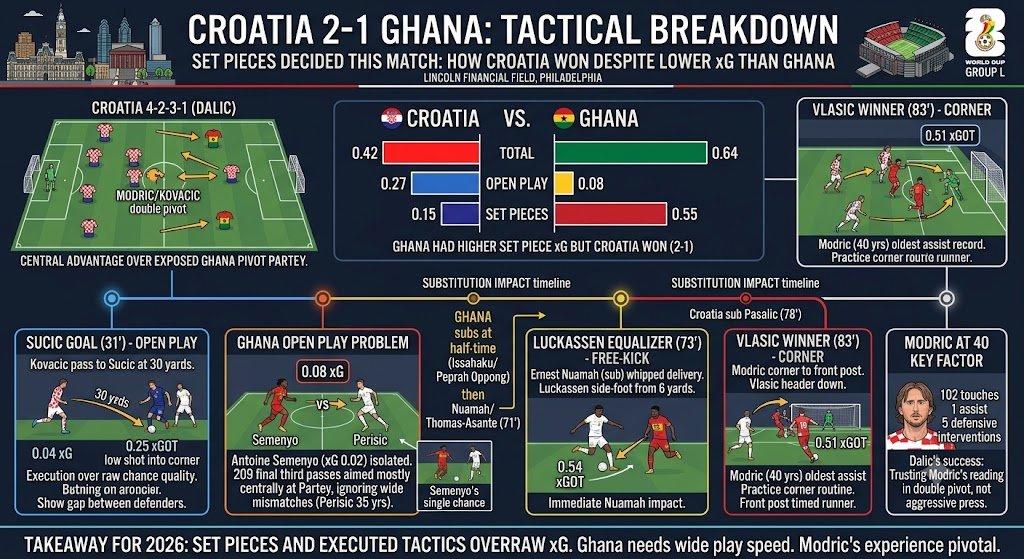
Croatia Won Despite a Lower xG Than Ghana and That Tells You Everything About 2026
Set pieces decided this match. That is the tactical story of Croatia’s 2-1 win over Ghana at Lincoln Financial Field in Philadelphia on June 28 in their 2026 World Cup Group L finale. Petar Sucic scored from open play in the 31st minute, Derrick Luckassen equalised from a free-kick delivery in the 73rd, and Nikola Vlasic headed home a Luka Modric corner in the 83rd to send Croatia through as group runners-up behind England. Ghana advance in third place and face Colombia next.
Croatia finished with an xG of 0.42. Ghana finished with 0.64. The team with fewer expected goals from better positions won the match 2-1. That gap exists almost entirely because of the set-piece column: Croatia generated 0.15 xG from set plays compared to Ghana’s 0.55, meaning Ghana created the higher-quality chances from dead-ball situations and still lost. When you look at open play xG alone, Croatia had 0.27 to Ghana’s 0.08. That number 0.08 from open play across 90 minutes is where Ghana’s real tactical problem lived.
How the formation matchup worked and where it broke down
Zlatko Dalic set Croatia up in their familiar 4-2-3-1, with Luka Modric and Mateo Kovacic operating as a double pivot two holding midfielders who sit in front of the back four to protect space and control tempo. Petar Sucic, Martin Baturina, and Nikola Vlasic played across the three attacking positions behind lone striker Ante Budimir. Against Ghana’s 4-1-4-1, with Thomas Partey as the single defensive midfielder in front of a back four, Croatia had a numerical advantage in central areas when Modric and Kovacic both pushed forward together.
Ghana’s structure relied on Partey covering the central channels alone when their four midfielders pressed high. Against most opponents that creates enough congestion to force mistakes. Against Croatia, with Modric’s movement constantly pulling Partey out of position and Kovacic arriving late into the space he left, it exposed Ghana in exactly the zone where Sucic’s goal came from. Kovacic played the ball into Sucic at 30 yards, Sucic found a gap between two defenders, and drove a low right-footed shot into the bottom left corner. The xG was just 0.04 on paper, a low-quality chance. The xGOT, which measures where he placed the shot, was 0.25. He put it exactly where Benjamin Asare could not reach it.
That is the difference between chance quality and execution, and it is why Croatia’s attacking output looked more threatening than the raw numbers suggest.
Ghana’s first half passive, cautious, and tactically conservative
For all the talent in Carlos Queiroz’s attacking line, Ghana were far too cautious in the opening 45 minutes. Antoine Semenyo, who had 17 Premier League goals last season and had been one of Manchester City’s better players, had just 30 touches across the full match and generated an xG of 0.02. That is not a finishing problem. That is a positioning and service problem.
Ghana’s 4-1-4-1 kept Kamaldeen Sulemana and Semenyo wide, with Semenyo in particular operating on the right side against Ivan Perisic, a left-back who is 35 years old and not especially quick. The mismatch was there. Ghana barely used it. Their forward passes into the final third 209 in total were consistently aimed at the central channel where Partey received and recycled rather than pushing the ball wide quickly to catch Croatia before they could recover shape.
Semenyo’s best moment came in the 40th minute, when he drove inside onto his right foot from the right channel and fired a shot that slid just past the left post. xG of 0.02. It was his only genuine attempt on goal across the full 90 minutes. That tells you almost everything about how well Croatia’s defensive structure Josip Sutalo covering centrally, Marin Pongracic protecting the box contained Ghana’s biggest individual threat.
The substitutions that changed the game and then gave it back
Queiroz made two changes at half-time, bringing on Fatawu Issahaku for Elisha Owusu and Kojo Peprah Oppong for Jonas Adjetey. The shape remained a 4-1-4-1, but the personnel changes gave Ghana more pace and directness. Issahaku came on and immediately looked more dangerous in tight spaces than what had preceded him. By the 71st minute, Queiroz sent on Ernest Nuamah and Brandon Thomas-Asante as well, abandoning the more controlled approach in favour of running power and delivery into the box.
Nuamah’s impact was immediate and decisive. Within two minutes of entering, he whipped a free-kick from the right centre of the pitch into the six-yard area, and Luckassen side-footed the ball into the bottom right corner from close range an xG of 0.54, a high-quality chance converted cleanly. The goal stood after a VAR check for offside. Ghana were level.
Then Dalic responded. He took off Kovacic in the 78th minute and brought on Mario Pasalic, shifting Croatia’s shape toward more direct box presence. Pasalic forced a save from Asare within four minutes of coming on, winning a corner. Modric delivered it. Vlasic got above his marker at the near post and nodded the ball down into the bottom left corner, clipping the inside of the post on its way in. An xGOT of 0.51 on that header Vlasic placed it perfectly.
Strip away the noise and the tactical story of the second half is simple: Ghana’s substitutions unlocked the match, then Croatia’s substitutions won it.
What Croatia got right and why Modric at 40 is still the key
Dalic’s single biggest tactical success was trusting Modric’s reading of the game in a double pivot role rather than forcing him into a more exposed position. Modric had 102 touches the most of any outfield player on either side completed one assist, and made five defensive interventions. He did not press aggressively or try to cover ground he no longer can at 40 years old. He positioned himself to receive, recycled possession quickly, and chose exactly when to push into the attacking third.
His corner delivery for Vlasic’s winner made him the oldest player to assist a goal at the World Cup in recorded history. That is a remarkable fact. Even more remarkable is that it came not from some inspired moment of individual genius but from a well-drilled corner routine a ball flighted to the front post, a runner arriving at the right time, a header placed with accuracy rather than power. Croatia had practised that. Ghana were not prepared for it.
The one fix Queiroz needs before facing Colombia
Ghana’s open play xG of 0.08 is the number Queiroz cannot ignore. His attacking players created almost nothing from open play in 90 minutes, despite having Semenyo, Sulemana, and eventually Issahaku and Nuamah all available. The fix is structural, not motivational. Ghana need to move the ball wide faster from the first whistle. Semenyo against opposing left-backs is a genuine advantage the side has, and they spent an hour of this match ignoring it entirely, passing sideways through Partey and inviting Croatia to hold a compact defensive block.
Against Colombia, if Queiroz waits until the 71st minute to play with speed and directness, he will pay the same price he paid on Saturday night.
Ghana were the better side in the second half. They needed to be that side from the first minute.