
Norway Rested 10 Players Against France and Paid the Full Price in 2026
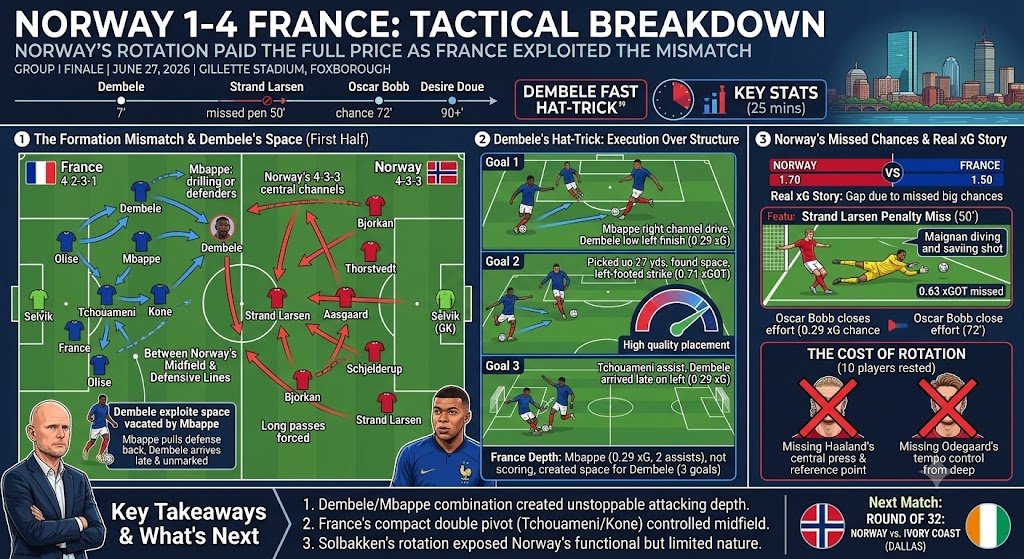
Twenty-five minutes. That is how long it took Ousmane Dembele to complete a hat trick at Gillette Stadium in Foxborough on June 27, making it the second-fastest in World Cup history. France beat a heavily rotated Norway 4-1 in their 2026 World Cup Group I finale, with Dembele scoring in the 7th, 20th, and 32nd minutes before Thelo Aasgaard pulled one back in the 21st and Desire Doue added a fourth in stoppage time.
Norway made ten changes to their starting lineup, resting Erling Haaland and nine other regulars with qualification already secured. France, with their place in the round of 32 also confirmed, picked their strongest available side. The tactical story of this match was decided before a ball was kicked.
Dembele scored three, Kylian Mbappe assisted twice, and Mike Maignan saved a second-half penalty from Jorgen Strand Larsen to keep the match from closing to 3-2. France win all three group games, the second time in their history they have done so. Norway go through in second place and face Ivory Coast in Dallas on Tuesday.
The formation mismatch that made France’s first half almost unfair
France lined up in their usual 4-2-3-1, with Aurelien Tchouameni and Manu Kone sitting as a double pivot two defensive midfielders who protect the back four and recycle possession while Dembele, Michael Olise, and Doue played across the three attacking midfield slots behind Mbappe. Against Norway’s starting eleven, which included a backup goalkeeper in Egil Selvik and a midfield three missing both Martin Odegaard and Erling Haaland, that front line was operating against players who had barely played tournament football together.
Norway’s 4-3-3 in theory offers width and vertical passing lines through the midfield. In practice, with Kristian Thorstvedt and Aasgaard asked to screen against Tchouameni and Kone, the structure kept breaking down in the central channels. France’s press from Dembele and Olise on either side forced Selvik and the back four into long passes that Norway’s makeshift front three could not hold up.
Dembele’s first goal in the 7th minute came from exactly this pattern. Mbappe drove down the right channel, Norway’s left side did not close the angle quickly enough, and Dembele arrived inside the box to drive a right-footed finish into the bottom left corner from 18 yards. His second, in the 20th minute, was even more instructive. He picked the ball up 27 yards from goal, found space between three defenders, and struck a left-footed shot that beat Selvik diving to his right. An xGOT the probability of a shot on target going in, based on placement of 0.71 on that second goal tells you Dembele placed it almost perfectly.
Fourteen seconds after that second goal, Aasgaard pulled one back for Norway, finishing from 17 yards after a smart cutback from Andreas Schjelderup. It was a good goal, and for roughly 60 seconds the match felt open. Then Dembele scored his third in the 32nd minute, assisted by Tchouameni, and it was over.
Why Norway’s shape could not protect the space Dembele exploited
Truth is, the tactical problem Stale Solbakken created by resting so many players was not simply about quality. It was about structure. Norway’s 4-3-3 requires the two wide forwards to press the opposition center-backs aggressively to force mistakes and trigger a high press that is, pushing the defensive line up the pitch to win the ball in the opponent’s half. Without Haaland as the central reference point who anchors that press and holds the ball for runners, the system relies on three attackers working in coordination to close down France’s back four together.
Jørgen Strand Larsen and Schjelderup simply did not do that. Strand Larsen had a 0.26 xG chance in the 14th minute a decent opportunity from 11 yards that Selvik should have been proud of him for creating but he and Schjelderup were largely absent from the pressing game. France played through Norway’s first line of defense almost at will. By the time Tchouameni and Kone received the ball in central midfield, Norway’s three central players were already running back rather than pressing forward, which meant Dembele and Olise consistently received in space between Norway’s midfield and defensive lines.
Olise had an xG of 0.51 across his three attempts, with one blocked chance from 14 yards in the 13th minute that had a higher quality than anything Norway created in the entire first half. France were carving Norway open every time they moved with speed.
The half-time changes and what they revealed
Solbakken made two changes at half-time, bringing on Marcus Holmgren Pedersen for Fredrik Bjorkan and Morten Thorsby for Thorstvedt. Neither change fundamentally altered Norway’s shape. Holmgren Pedersen added more defensive security on the right side, while Thorsby gave more physicality in central midfield. Those are logical adjustments, but they told you Solbakken’s priority after the break was damage limitation rather than reclaiming the match.
The second half was quieter, which was partly the result of France managing the game sensibly and partly Norway’s improved defensive shape. Strand Larsen’s penalty miss in the 50th minute Maignan diving to his right to push it wide, an xGOT of 0.63 ended any realistic chance Norway had of turning the game into something uncomfortable. Oscar Bobb had a sharp left-footed effort in the 72nd minute from the centre of the box, xG of 0.29, that Maignan stopped low at his left post. By then France had already made four substitutions and were rotating their squad.
Still, Norway’s open play xG of 1.70 across the full match higher than France’s 1.50 shows there was more to them than the scoreline suggests. Much of that came from the missed penalty and Bobb’s second-half chances. The real Norway, with Haaland and Odegaard restored, will look different against Ivory Coast.
What Dembele’s hat trick tells you about France’s tactical depth
For all the talk about Mbappe being France’s decisive weapon, this match showed something important. Mbappe did not score. He had four shots, assisted twice, and hit the crossbar inside the first minute, but his personal xG was just 0.29. Dembele created the hat trick almost entirely from positions Mbappe vacated arriving late into space on the right and left of the central channel while Mbappe pushed the defensive line back. That combination, where Mbappe’s movement opens space for Dembele’s runs, has produced eight France goals in three games and it was not something Norway’s backup defensive line had any credible answer for.
Didier Deschamps got three things right tactically. He kept Tchouameni and Kone compact to deny Norway any numerical advantage in midfield. He trusted Olise in a free attacking role where Norway’s right side was exposed. And he gave Dembele the license to arrive late from the right, unmarked, into the space Mbappe was pulling away from. It is a simple combination. Against this Norway lineup, it was also unstoppable.
The one fix Solbakken needs before Tuesday
Norway face Ivory Coast in Dallas with a very specific problem to solve. Aasgaard was their most energetic midfielder on the night, with 65 touches and a goal. But he was also playing behind a defensive structure that kept breaking down at the seams between midfield and defense. The fix is not tactical in a grand sense it is about restoring the players who make Norway’s system work. Odegaard needs to start and control the tempo from a deeper position, and Haaland needs to give the team a focal point to press from.
Without both of them, Norway are a functional but limited side. With both, they are capable of beating anyone at this level on a given day.
Whether Solbakken trusts that combination from the first whistle against Ivory Coast, rather than treating the round of 32 as another rotation opportunity, is the only question that actually matters now.