
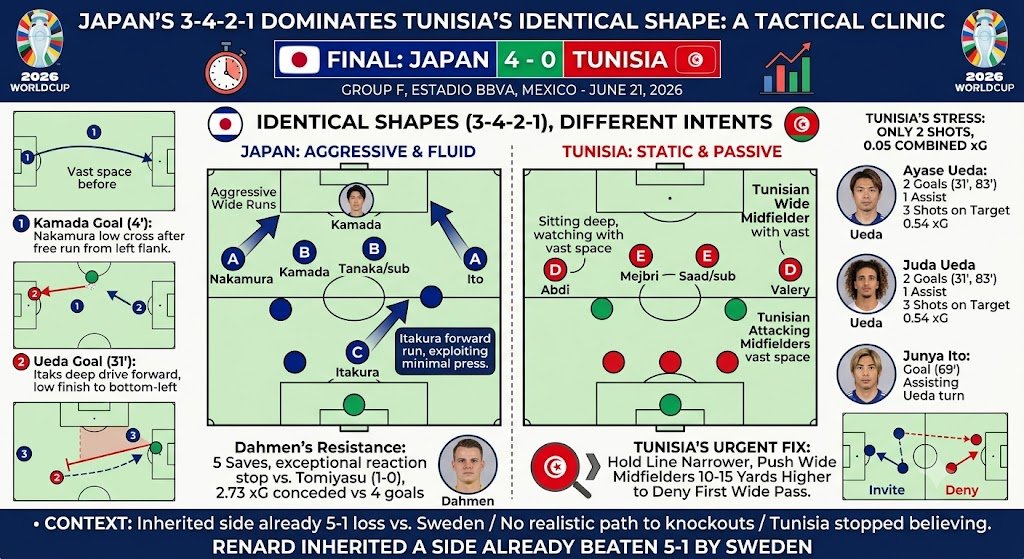
Japan’s 3-4-2-1 Attacked Every Gap in Tunisia’s Identical Shape and Won 4-0 at the 2026 World Cup
Two shots. That is what Tunisia managed across ninety minutes at Estadio BBVA in Guadalupe, Mexico on June 21, 2026. Combined xG: 0.05. Japan beat Tunisia 4-0 in their Group F match at the 2026 World Cup, with Daichi Kamada scoring in the 4th minute, Ayase Ueda adding goals in the 31st and 83rd, and Junya Ito completing the rout in the 69th. Tunisia are eliminated. Japan move level with the Netherlands on four points, separated only by goal difference.
Both sides set up in a 3-4-2-1 three defenders at the back, four across the midfield, two attacking players behind a lone striker. On paper, the mirror image should produce a contest. In practice, it produced a clinic. Japan’s version of the shape was aggressive and fluid; Tunisia’s was passive and static. That gap in intent explained the scoreline better than any individual performance.
Make no mistake, this was tactical failure as much as anything else.
Japan’s wide midfielders Keito Nakamura on the left and Junya Ito on the right operated as genuine wide forwards rather than defensive contributors. In a 3-4-2-1, the two wide midfielders are responsible for covering huge areas of the pitch, tracking back when the opposition attacks and pushing forward when the team has the ball. Tunisia’s wide midfielders, Ali Abdi and Yan Valery, spent the majority of the game sitting deep, watching Japan’s wide players receive the ball with no pressure on them whatsoever. Nakamura’s cross for the first goal in the 4th minute arrived from exactly that situation: he received the ball on the left flank with thirty yards of space in front of him, drove to the byline, and cut it back for Kamada to tap in from four yards.
Tunisia’s two attacking midfielders Hannibal Mejbri and Elias Saad, operating in the pockets behind the lone striker were supposed to press Japan’s three centre-backs when they had the ball, disrupting their build-up and forcing errors. Mejbri finished the game with 51 touches and one shot, but his pressing output was minimal. Japan’s captain Kou Itakura made 101 passes from centre-back, the most of any outfield player in the match. That number does not happen when a pressing midfielder is doing his job. Itakura had time to pick his passes, drive forward, and set the second goal up himself his forward run from deep assisted Ueda’s low finish into the bottom-left corner in the 31st minute.
Ueda was the clearest individual story of the evening, finishing with two goals, one assist, three shots on target, and an xG of 0.54 from five attempts. But his performance was built on the patterns Japan created rather than moments of improvised brilliance. For the third goal in the 69th minute, Ao Tanaka played the ball into Ueda’s feet in the channel the space between Tunisia’s central defenders and wide midfielders and Ueda’s first touch turned him immediately into Ito’s path, who finished calmly. That space between Tunisia’s defence and midfield was available all game because Tunisia’s midfield never pushed up to close it.
Tunisia did one thing well. Goalkeeper Aymen Dahmen made five saves and produced one exceptional stop in the first half, clawing Takehiro Tomiyasu’s close-range effort off the line with a reaction save that briefly kept the score at 1-0. A different result in that moment and the psychology of the match changes. Dahmen could not be faulted for any of the goals; his xG conceded was 2.73 against four goals actually scored, meaning Japan underperformed their chances even in a 4-0 win.
Tunisia made two substitutions at half-time Mohamed Amine Ben Hamida for Dylan Bronn and Ismael Gharbi for Elias Saad but both were reactive rather than structural. Renard was trying to freshen the personnel without changing the shape, which was the problem in the first place. Japan’s response was to keep doing exactly what they had been doing, then begin rotating their own squad from the 73rd minute onward: four substitutions in eleven minutes, managing minutes, protecting their players for Sweden.
For the Tunisia coach and this applies equally to whoever leads them against the Netherlands in their final game the concrete adjustment is in the positioning of the wide midfielders at the moment Japan receive the ball in their own defensive third. Abdi and Valery need to be positioned ten to fifteen yards higher up the pitch at that trigger point, pushing Japan’s wide midfielders back rather than inviting them forward. Every Japan goal started with a free run from wide areas that Tunisia never attempted to prevent. Hold the line narrower and push the wide midfielders up: not to press wildly, but to deny the first pass. Tunisia gave Japan that first pass on a plate, over and over, and Japan scored four times as a result.
Hervé Renard inherited a side already beaten 5-1 by Sweden before he arrived. There was no realistic path to the knockout stage. Still, two shots in a World Cup group-stage match is not bad luck. That is a team that stopped believing before the referee blew his whistle.