
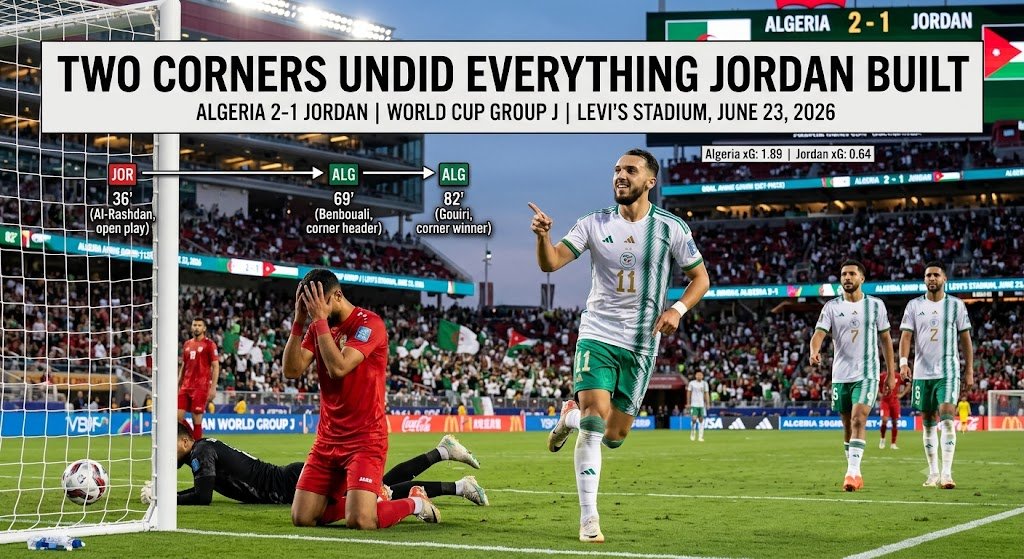
Two Corners Undid Everything Jordan Built
Two corners. That is all it took to erase a Jordan lead that had held for thirty-three minutes, and both of them landed in exactly the same place.
Algeria beat Jordan 2-1 at Levi’s Stadium in Santa Clara, California, on June 23, 2026, in their second Group J match at the World Cup. The result eliminates tournament debutants Jordan from contention, while Algeria move to three points and set up a final group game against Austria with second place in the group still open.
Here are the basics for anyone catching up. Algeria beat Jordan 2-1. Nizar Al-Rashdan put Jordan ahead in the 36th minute, before substitute Nadhir Benbouali equalized with a header in the 69th and Amine Gouiri scored the winner in the 82nd, both goals arriving from corners. Algeria finished with 1.89 expected goals to Jordan’s 0.64. Jordan finish bottom of Group J and close out their World Cup debut against Argentina, while Algeria still control their own fate.
Jordan lined up in a 3-4-2-1, with three center-backs designed to absorb pressure and two wide midfielders providing width. Algeria played their usual 4-2-3-1, built around Riyad Mahrez drifting from the right and Ibrahim Maza floating centrally behind the striker. For most of the first half, Jordan’s back three did exactly what it was built to do, holding a back line that conceded almost nothing in open play.
Here is the direct story of how this game actually swung.
Jordan’s opening goal came from broken play rather than a set pattern. Mousa Al-Tamari carried the ball into the box, cut it back, and after a mishit from Mahmoud Al-Mardi the ball fell kindly for Al-Rashdan to drill home. It was a goal built on instinct and willing running rather than a tactical plan, the kind of moment that can carry a debutant team only so far against a side dominating possession at 72 percent.
What changed Algeria’s chances was not a formation switch. It was a personnel one. Bringing on Benbouali for Hicham Boudaoui at halftime gave Algeria a recognized number nine, and his ability to win headers in the box turned every corner into a genuine threat rather than a routine clearance opportunity. Mahrez delivered both decisive corners himself after coming inside from the right, first finding Benbouali’s head for the equalizer, then later combining with substitute Anis Hadj Moussa to set up Gouiri’s winner.
Make no mistake, Jordan’s resistance in open play deserves real credit. Algeria managed only 0.80 expected goals from open play across the entire match, meaning nearly all of their attacking threat came from sets pieces rather than breaking down a back three that mostly held its shape. Jordan’s three center-backs, Yazan Al-Arab, Abdallah Nasib and Husam Abu Dahab, won duels and blocked lanes competently for long stretches.
The numbers reveal exactly where this game was decided. Algeria’s set-piece expected goals reached 1.09 against Jordan’s 0.26, and both genuine goals against the run of general play came from corners rather than buildup football. That gap is not bad luck. It is a back three that, for all its discipline in open play, lost both critical aerial duels in the box at the moments that mattered most.
Vladimir Petkovic’s biggest call paid off precisely because it targeted that specific weakness. Rather than chasing the game with more pace or width, he introduced a target man whose entire value was winning the exact kind of header Jordan’s smaller wide players struggled to contest, then doubled down with another fresh runner in Hadj Moussa to keep service flowing into the box.
For Jamal Sellami, the fix heading into the Argentina finale is specific and unglamorous. Jordan needs a designated zonal marker assigned to the back post on every corner, since both goals came from deliveries that found space precisely there. Against a far stronger Argentina side, conceding twice from corners would not just end one match. It would end the tournament with a wider gap than the scoreline ever needed to show.
Jordan led for thirty-three minutes against a side they were never expected to trouble. In the end, two set pieces meant their World Cup debut ends without a single point to show for it.