
Norway’s Midfield Stranglehold Made This Result Inevitable World Cup 2026
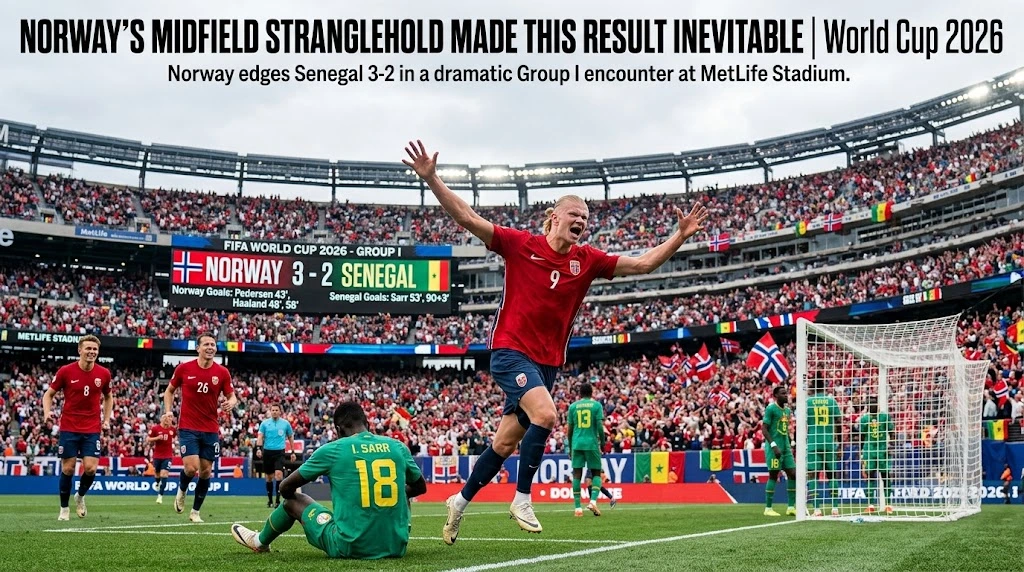
Fifty-seven duels won to 38. That number did not appear on the scoreboard at MetLife Stadium in East Rutherford, New Jersey, on June 23, 2026, but it explains almost everything about how Norway beat Senegal 3-2 in their Group I match at the 2026 World Cup. Marcus Holmgren Pedersen scored in the 43rd minute before Erling Haaland added goals in the 48th and 58th to put the result beyond doubt. Ismaila Sarr pulled two back for Senegal in the 53rd minute and deep into stoppage time but the Lions of Teranga were chasing a result that Norway’s shape had made structurally unavailable to them from the first whistle.
Norway beat Senegal 3-2. Norway’s goals came from Pedersen in the 43rd minute, Haaland in the 48th assisted by Martin Odegaard, and Haaland again in the 58th assisted by Patrick Berg. Senegal’s two came from Ismaila Sarr, both from the centre of the box. Norway are through to the last 32, finishing with an xG of 2.20 to Senegal’s 1.72 despite holding only 42% of the ball.
Strip away the noise about Haaland’s historic brace he became only the second player in 50 years to score twice in each of his first two World Cup appearances, following Harry Kane in 2018 and the real story here is a midfield setup that made Senegal entirely predictable long before the goals arrived.
Norway lined up in a 4-3-3, with Sander Berge and Fredrik Aursnes sitting deep in front of the back four while Odegaard operated higher and wider on the right. That double pivot Berge and Aursnes occupying the central lanes had a very specific purpose: cut off the direct passing lines through the middle that Senegal rely on to transition from their 4-2-3-1 into dangerous positions. Idrissa Gueye, who finished with 70 passes and 63 accurate ones, had the ball constantly but almost nowhere to go with it. He was the most active midfielder on the pitch by volume and arguably the least impactful. That is not an accident. That is Berge and Aursnes doing their jobs with something close to perfection.
The tactical consequence was immediate and damaging for Senegal. Forced out of the middle, they fell back on wide delivery crossing from areas where Norway’s defenders were already set, waiting, and entirely comfortable.
Moussa Niakhate won 10 duels. Kristoffer Ajer won six. Torbjorn Heggem patrolled the left channel aggressively enough to be involved in both set-piece clearances and scrambles for the entire 84 minutes he was on the pitch. Senegal’s 26 touches in the opposition box looked reasonable on paper, but the quality of those touches blocked shots, headers over, a Nicolas Jackson offside that killed one promising move tells the real story.
Here is the thing Senegal actually had the ball. Fifty-eight percent of possession, 489 passes compared to Norway’s 353, 430 accurate. And yet Norway created four big chances to Senegal’s three. Possession without access to the central channel is just recycling in uncomfortable territory. Sadio Mane, who touched the ball 62 times, created one big chance and spent much of the evening drifting wide looking for space that was never going to appear.
The first goal came from exactly the pattern Norway had been building toward. Odegaard’s pass was cleared only as far as Pedersen at the top of the box, and the substitute in for the injured Julian Ryerson from the 13th minute fired through Edouard Mendy’s near post at the end of a move that originated from sustained set-piece pressure. Senegal gave the ball away cheaply; Kalidou Koulibaly’s clearance did not find a teammate. That is what happens when a midfield cannot absorb the press and distribute cleanly under pressure.
The second and third goals came from the counter, which is where Norway are genuinely lethal in ways that still feel underappreciated. Aursnes was replaced at half-time by Patrick Berg, a more direct, forward-carrying presence, and the adjustment was almost immediately visible. Odegaard found Haaland with a through ball in the 48th minute after Norway broke from deep at pace four Norway players moving against a Senegal line that had pushed up looking for an equaliser they did not yet need. Then in the 58th, Berg drove into the right channel and played Haaland in from eight yards. Simple, fast, devastating. Norway do not need a lot of the ball. They need the right moments with it.
Senegal made four substitutions before the hour mark and were effectively managing panic as much as tactics by that point. Mendy went off injured in the 63rd minute, replaced by Mory Diaw, and the goalkeeper change disrupted whatever defensive structure Aliou Cisse had left to work with. Koulibaly followed him off at the 72nd minute, replaced by a midfielder in Pape Matar Sarr an open acknowledgment that the team needed an attacking solution and had run out of defensive answers.
One thing Senegal did well, and it deserves saying: Ismaila Sarr never stopped. Six shots, three on target, 1.21 xG, and two goals scored. Both of his finishes were composed under pressure from inside the box. He gave Nyland a genuine scare late on, and his second goal finished in the 93rd minute from Jackson’s squared pass was clean, sharp, and deserved. Against a better-organized Norway, his individual quality was the one thing Senegal could point to. Without him, this is a very different-looking final scoreline.
For Norway’s coach, the one real lesson from this game is how quickly comfort can breed sloppiness. After the third goal, Norway stopped pressing and sat. They committed 13 fouls to Senegal’s five, conceded nine minutes of added time, and were hanging on to a lead they had built with authority. Ostigard came on with six minutes left and was immediately dealing with a near-post cross. Pedersen left the pitch cramping before the final whistle. The closing stages had an edge of anxiety that a 3-1 lead should not carry.
Make no mistake, though: Norway controlled this match in the only way that matters. Not through possession, but through space. By taking away the middle of the pitch, they forced Senegal into a game plan that suited Norwegian defenders perfectly. Senegal lost 57 duels to Norway’s 38. Most of those losses happened in wide areas and at the back post, which is exactly where Norway wanted them to happen.
If Senegal are to beat Iraq and sneak through as a third-place team, Aliou Cisse needs to solve the central problem this game exposed. Not defending better defending from a more compact shape in the first place. Sitting two midfielders deeper, giving Gueye a genuine screen in front of the back four, and accepting that Senegal’s best attacking play comes from quick, direct transitions rather than sustained possession that leads nowhere. The talent is there. The structure, against Norway, was not.
Ismaila Sarr scored twice in a losing effort at a 2026 World Cup match where Senegal had more of the ball, more passes, and more duels. That is a reasonable summary of what a well-constructed midfield block can do to even talented opposition. Norway did not outrun Senegal. They simply made every direction except backward unavailable until it was too late.