
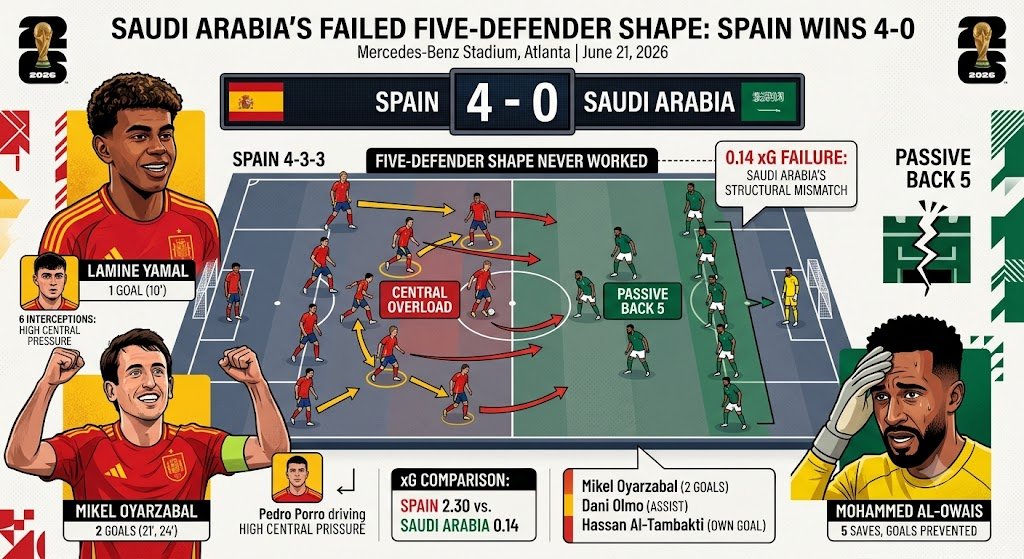
Saudi Arabia Offered Spain 0.14 xG and a Five-Defender Shape That Never Worked 2026 World Cup
Spain beat Saudi Arabia 4-0 at Mercedes-Benz Stadium in Atlanta on June 21, 2026, in their second Group H match of the 2026 World Cup. Lamine Yamal scored in the 10th minute, Mikel Oyarzabal added two more in the 21st and 24th, and Hassan Al-Tambakti turned Marc Cucurella’s shot into his own net in the 49th. Saudi Arabia generated 0.14 xG across the full ninety minutes. Spain generated 2.30.
Truth is, this was over before most people had found their seat. Saudi Arabia coach Roberto Donis set his side up in a 5-4-1 five defenders across the back, four midfielders in a flat line in front of them, one forward isolated at the top designed to keep Spain out. The shape worked for approximately nine minutes. Then Porro drove forward from right-back and pulled the ball across the face of goal, Oyarzabal’s touch was controlled and clever, and Yamal arrived at the back post from five yards to finish. Three goals in fourteen minutes later, every tactical calculation Donis had made was irrelevant.
The mismatch at the heart of Saudi Arabia’s problems was structural. A flat back five needs its wing-backs the two wide defenders who push forward to attack and drop back to defend to press aggressively when Spain’s full-backs received the ball, cutting off the wide channels before Spain could play through them. Saudi Arabia’s wing-backs never did that. Saud Abdulhamid, the right wing-back who plays for Roma and knows how to defend high up the pitch, sat deep for long stretches, leaving Pedro Porro with space to drive forward and cross repeatedly. Porro finished the game with 11 defensive interventions on his own side, three tackles won, and more forward threat than anyone Saudi Arabia could offer.
Spain’s 4-3-3 four defenders, three midfielders, three forwards was designed specifically to overload the central midfield zone. Rodri sat deepest, pulling the ball out from defence and distributing. Pedri and Dani Olmo moved ahead of him, one going narrow and the other wide depending on where Yamal had pulled Saudi Arabia’s defensive line. That movement Pedri or Olmo stepping into the half-space between Saudi Arabia’s central defenders and wide midfielders is what created the second and third goals. Olmo was credited with an assist for Oyarzabal’s first; his run inside from the right opened the path to goal. For the second, Oyarzabal received the ball six yards out and had so little pressure on him that he could pick his spot.
Saudi Arabia’s midfield four were entirely passive throughout the first half. They did not press. They waited. Pedri finished with six interceptions the most by any player in a single match at this tournament so far not because Pedri is uniquely combative, but because Saudi Arabia kept losing the ball in the same central zone, over and over, where Pedri was positioned to win it straight back. That is a pattern, not bad luck.
Still, Mohammed Al-Owais deserves credit he will not get from the scoreline. He made five saves on the night, several of them sharp, and his xG against was 3.45 while he conceded four. Goals prevented as a metric: minus 0.55, meaning he kept Spain to four when the underlying numbers suggested closer to five or six. Ferran Torres hit the post from close range, a VAR offside ruling cancelled a fifth, and another Torres effort was saved well at the near post. Saudi Arabia were not just beaten; they were fortunate the margin was not wider.
De la Fuente’s double substitution at half-time both Yamal and Oyarzabal withdrawn after scoring between them was not cautious management. It was a statement of intent in the opposite direction: protect your best players, rotate the squad, keep everyone fresh. When a coach can take off his hat-trick-threatening striker at half-time and still win by four, the game is effectively over as a contest.
For Donis, the concrete adjustment before the Saudi Arabia match against Cape Verde is not tactical, it is positional. His wing-backs particularly the right side need a clear instruction to push up and pin back Cape Verde’s full-backs when Saudi Arabia have the ball, and to press within ten yards when Cape Verde’s centre-backs receive it. A flat 5-4-1 that never breaks its shape offers no width in attack and no pressure in defence. Against Cape Verde, who showed against Uruguay and Spain that they will exploit any dropped line, sitting deep will produce the same result it produced here.
Saudi Arabia did not lose this because Spain were brilliant, although Spain were often brilliant.
They lost it because their shape asked nine players to defend a Spain side that creates goalscoring chances through movement and overloads in central areas and gave those nine players no instruction to do anything other than wait.