
Uruguay’s Midfield Controlled 65% of the Ball and Still Could Not Win 2026 World Cup Group H
Strip away the noise and the real story of this Group H encounter at Hard Rock Stadium in Miami on June 22, 2026 is not that Cape Verde held Uruguay to a 2-2 draw. It is that Uruguay generated 2.32 xG expected goals, a measure of how good a team’s chances actually were and converted just two of them, both arriving in a frantic six-minute window at the end of the first half, both gifted by defensive chaos rather than built through design. Kevin Pina scored for Cape Verde in the 21st minute, Maxi Araujo levelled in the 44th, Agustin Canobbio put Uruguay ahead in first-half stoppage time, and substitute Helio Varela equalised in the 61st. Before a crowd of 64,003, Cape Verde, in their first ever World Cup finals, twice came from behind. Marcelo Bielsa’s Uruguay are now two points from two games with Spain to come.
The xG gap looks damning on paper. Uruguay: 2.32. Cape Verde: 0.89. Uruguay won. Uruguay lost. Both of those things are completely true, depending on which half you watched.
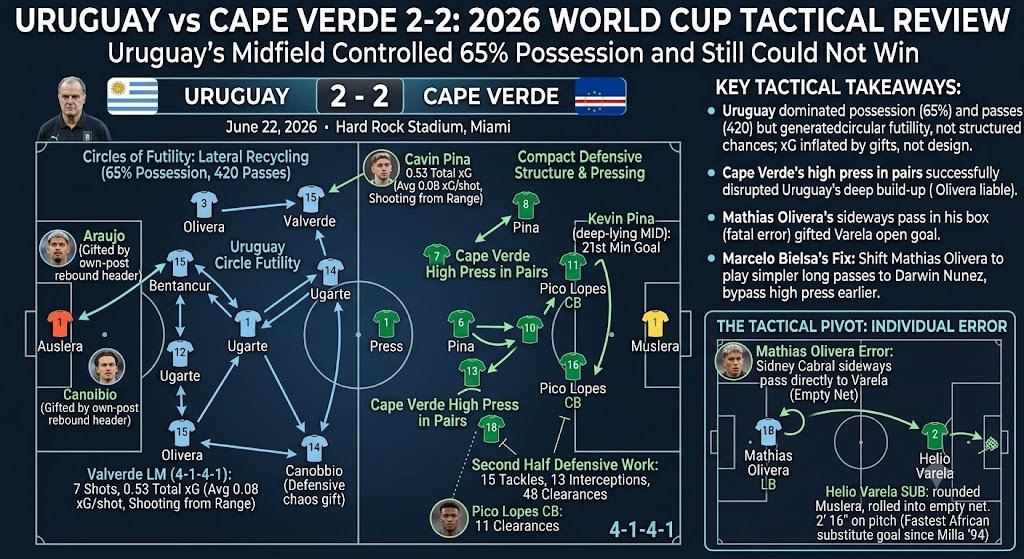
Here is the thing the numbers hide a tactical truth that actually favours Cape Verde. Uruguay’s xG was inflated almost entirely by two moments of individual quality and one defensive own goal rather than by the system creating clear paths to goal. Federico Valverde, playing as a left-sided midfielder in a 4-1-4-1 shape, fired seven shots across the ninety minutes.
Combined xG from those seven attempts: 0.53. That is an average of 0.08 per shot. He was shooting from range, repeatedly, from positions that rarely produce goals. Uruguay’s best chance on open play in the first half came not from a structured move but from Sidny Lopes Cabral heading against his own post under pressure from Rodrigo Bentancur, the rebound falling to Araujo three yards out for a 0.89 xG header he could not miss.
Both teams set up in matching 4-1-4-1 formations, which on paper looks like a neutral shape. In practice it was not neutral at all. Cape Verde had no intention of mirroring Uruguay’s approach with the ball. They sat their defensive midfielder, Kevin Pina, just in front of the back four, keeping him narrow and compact, and asked the four midfielders ahead of him to press in pairs when Uruguay’s centre-backs had the ball. Uruguay, with 65% possession and 420 accurate passes to Cape Verde’s 205, simply recycled laterally rather than progressing through that press. Mathias Olivera made 80 passes at left-back, the highest on the pitch most of them sideways. Uruguay were not building; they were circling.
Cape Verde’s defensive numbers tell the real story of the second half. Fifteen tackles, 13 interceptions, 48 clearances. Pico Lopes, the centre-back, made 11 clearances in the first game against Spain and was at it again here. Uruguay had 34 touches in the opposition box to Cape Verde’s 10, yet Cape Verde had more shots on target. That ratio more shots on target from fewer attacking entries speaks to the quality of the positions Cape Verde found, as opposed to the volume Uruguay produced without reward.
The tactical pivot that changed the game came not from a coaching decision but from a moment of individual error so bad it almost defies description. Olivera, the same left-back who had spent the entire match passing the ball sideways to nobody’s benefit, turned inside his own box in the 61st minute and played a pass directly to nobody a sideways ball that drifted into open space and invited Varela, on the pitch for less than three minutes, to run onto it, round Fernando Muslera and roll into an open goal from outside the box. Olivera was booked three minutes earlier for a bad foul. He had already been flagged as a liability before the goal arrived.
Bielsa’s double substitution at 70 minutes Darwin Nunez for Federico Vinas, Nicolas de la Cruz for Manuel Ugarte was the right call on paper. Nunez provides a focal point; de la Cruz carries the ball. In practice, neither could unpick a Cape Verde block that grew more organised as the game went on. Jamiro Monteiro, who had caused near-constant problems from midfield and finished with two shots and nine defensive interventions, was withdrawn at 80 minutes through injury but by that point Cape Verde had already shifted into a defensive shape with five players behind the ball at all times. Yannick Semedo’s introduction simply confirmed what the coaching staff already knew: the point was worth protecting.
Make no mistake, Uruguay should have won this. Their xG on target was 1.65; Cape Verde’s was 1.26. Even goalkeeper Vozinha’s stats reflected the balance he faced 12 shots and made zero saves, while Muslera faced 17 and made two. But Muslera also walked fifteen yards outside his box to collect a pass that never reached him and handed Cape Verde their equaliser. Goalkeepers doing that at a World Cup generally pay for it.
For Bielsa, the concrete fix is not tactical but positional. Olivera cannot operate as the deepest passer in a 4-1-4-1 under pressure. He gave the ball away in dangerous positions three times, not just the one that led to the goal. Bielsa needs Olivera to play earlier and simpler clip the ball long to Nunez rather than turn and circulate from deep.
Cape Verde’s high press in pairs worked precisely because Olivera refused to go long when Uruguay had the ball in their own third. One adjustment to that trigger point changes the balance of the entire first pass. Whether Bielsa makes it against Spain, whose press is far more organised and relentless than Cape Verde’s, is a different question entirely.
Helio Varela tapped the ball into an empty net two minutes and sixteen seconds after coming on. That is the fastest goal by an African substitute at a World Cup since Roger Milla scored for Cameroon against Russia in 1994. He did not earn it with clever movement or a well-timed run. He earned it because Mathias Olivera forgot where his own goalkeeper was standing.