
Egypt’s Second-Half Crossing Game Undid New Zealand’s Defensive Plan World Cup 2026
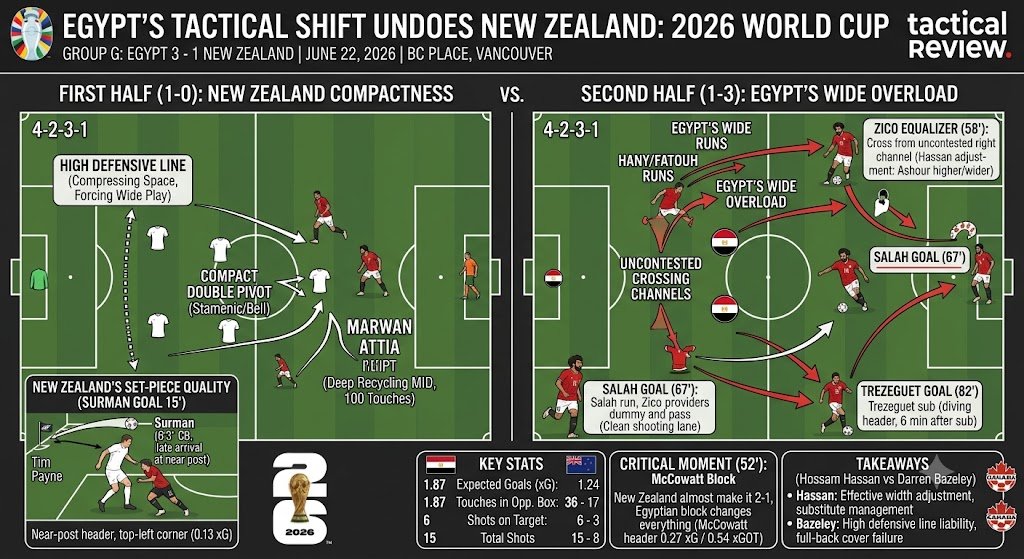
Seventeen touches in the opposition box versus 36. That gap between New Zealand and Egypt in their Group G match at BC Place in Vancouver on June 22, 2026, explains more about this 3-1 result than the scoreline does on its own. Egypt were the better team across 90 minutes, but they were not the better team for the first 45. New Zealand led at half-time, defended with real discipline for long stretches, and still lost by two goals.
Egypt beat New Zealand 3-1: Finn Surman headed the opener in the 15th minute, Mostafa Zico equalized in the 58th, Mohamed Salah put Egypt in front in the 67th, and Trezeguet headed a third in the 82nd. Egypt finished with an xG of 1.87 to New Zealand’s 1.24, and the match turned on a very specific tactical shift that happened without a formation change on either side.
Both teams lined up in a 4-2-3-1. The mismatch was not structural. It was about how Egypt used the width of the pitch in the second half compared to the first, and how New Zealand’s high defensive line pushing up to compress space and force play wide gradually became a liability rather than an asset as Egypt’s crossing accuracy improved.
New Zealand’s first goal came from their own set-piece quality, not from any failing in Egypt’s shape. Surman, a 6-foot-3 centre-back playing out of position on the right of defence, arrived late at the near post from Tim Payne’s corner delivery, got above his marker, and directed a header to the top-left corner. A 0.13 xG chance that went in. For all that Egypt had more of the ball in the opening 15 minutes, they were undone by one simple dead-ball routine and a defender who read the flight of the cross earlier than anyone around him.
Still, Egypt did not panic. They maintained their shape, kept the ball in wide areas, and waited for New Zealand’s compactness to open. Marwan Attia the deepest-lying of Egypt’s midfield pair finished the game with 100 touches and 87 accurate passes. That volume does not come from a player under pressure.
It comes from a player with time on the ball, one who is finding short passes into safe positions while the team recycles and looks for better angles. New Zealand’s double pivot of Marko Stamenic and Joe Bell did their jobs without necessarily dominating Stamenic made two big chances created, Bell covered the ground but neither could fully prevent Egypt from finding Mohamed Hany and Ahmed Fatouh overlapping at full-back.
Hamdy Fathy’s injury in the 41st minute forced Egypt’s hand. He was replaced by Ramy Rabia a more defensive-minded presence and the switch initially made Egypt slightly more compact. But at half-time, Egyptian coach Hossam Hassan made an adjustment that proved decisive: he pushed Emam Ashour higher and wider on the left, essentially telling him to attack the full-back channel rather than sit between the lines. Ashour’s shot in the 55th minute which led to the sequence for Zico’s goal three minutes later came from a run exactly into that space.
Zico’s equalizer was headed home from Mohamed Hany’s cross from the right. A cross. Into a central channel. Against a back line that had been high and narrow all half. New Zealand’s defenders were not beaten for pace or skill.
They were beaten because Egypt’s full-backs were crossing from positions that New Zealand’s wide midfielders had stopped tracking by that point in the game.
Callum McCowatt’s yellow card in the 34th minute had already affected his positioning. A booked winger in a game where your team is ahead is a winger who does less pressing, stays slightly deeper, creates a little more space behind him. By the time Hany arrived to deliver the cross for Zico’s equalizer, the right channel was uncontested.
Make no mistake: Salah won this match. Not because of his individual quality alone, but because of how he moved. For his goal in the 67th minute, Zico turned provider rather than finisher checking away from the centre, drawing attention, and sliding a pass into Salah’s run from the right. Salah arrived at the ball already facing goal from 17 yards and finished low to the bottom-left.
The run was timed precisely to breach the gap between New Zealand’s retreating centre-back and their right midfielder, who had already been pulled across by Zico’s dummy. Two players making two decisions in two seconds that created a clean shooting lane.
New Zealand had one genuine moment in the second half that could have changed the match. McCowatt’s header from seven yards in the 52nd minute 0.27 xG, 0.54 xGOT was blocked on the line.
Had that gone in, New Zealand would have led 2-1 and Egypt would have needed to chase a result rather than protect one. The block changed everything. Six minutes later, Zico scored.
Trezeguet’s third goal in the 82nd minute came from a corner, diving to meet Salah’s outswinging delivery at the near post with perfect timing. Egypt are, as recorded, the second CAF side to score two headed goals in a single World Cup match since 1966, following Ivory Coast against Japan in 2014. That tells you something about Egypt’s delivery quality on set pieces when they were going forward with confidence.
Egypt’s substitutes were well managed. Trezeguet, who came on at 76 minutes, scored six minutes later. That is a coach reading the moment correctly the match was still live at 2-1, and sending on a forward-type with heading ability before a corner routine was precisely the right call.
For New Zealand coach Darren Bazeley, the specific change needed against Belgium is a defensive adjustment at the full-back position. Not a change of formation their 4-2-3-1 gave them structure and discipline.
The problem was that Tim Payne and Liberato Cacace pushed high repeatedly throughout the second half without adequate cover from the wide midfielders ahead of them. When Egypt recovered the ball in transition, New Zealand had two full-backs out of shape and a double pivot covering too much ground.
Against Belgium who will attack with width and pace Bazeley needs his wide attackers to track back into a defensive shape when possession changes. Singh and McCowatt ran forward enthusiastically. Neither one tracked back consistently.
New Zealand were not bad. They were organized, set-piece-dangerous, and created enough to make it close. Against a side with Salah in it, that was not quite enough.