
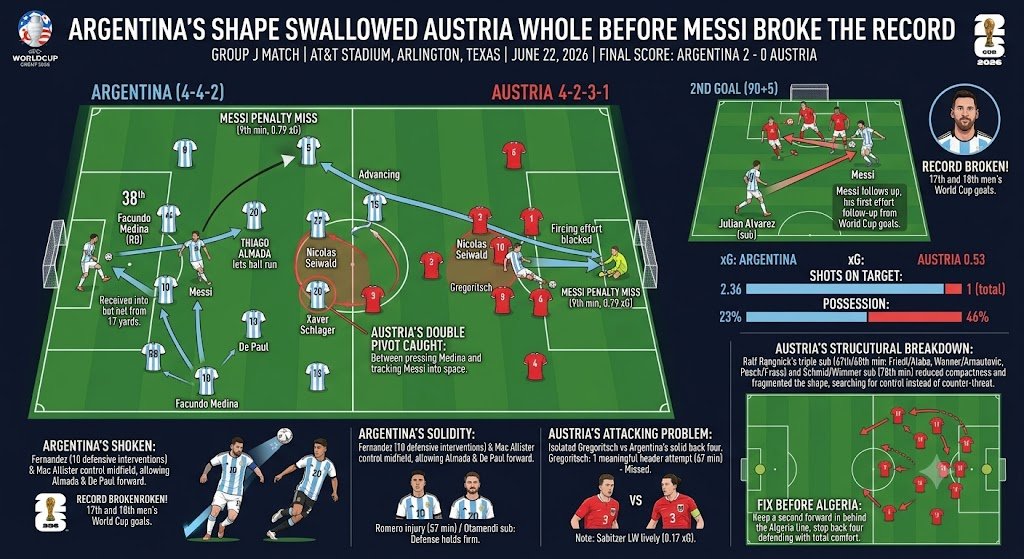
Argentina’s Shape Swallowed Austria Whole Before Messi Broke the Record World Cup 2026
Argentina’s xG was 2.36. Austria’s was 0.53. Those numbers came out of a 90-minute Group J match at AT&T Stadium in Arlington, Texas, on June 22, 2026, in which Austria had the ball 46% of the time and managed one shot on target for the entire game. Argentina beat Austria 2-0, with Lionel Messi scoring in the 38th minute and in the fifth minute of stoppage time to set a new men’s World Cup scoring record with his 17th and 18th goals. The record will get all the attention. It deserves some. But the tactical story of this match is quieter and more instructive, and it has almost nothing to do with Messi individually.
Argentina lined up in a 4-4-2 a flat four in midfield, two strikers ahead of them against Austria’s 4-2-3-1. Messi played on the right side of the forward pair alongside Lautaro Martinez, which meant he spent long stretches of the first half operating in wide areas before cutting inside. Austria’s double pivot of Nicolas Seiwald and Xaver Schlager two deep-lying midfielders providing the defensive screen was asked to cover both the central lanes and track Messi’s dropping runs. They could not do both.
The first goal came directly from that failure. Facundo Medina drove forward from right-back the full-back who pushes up to support attacks and played a pass inside to Thiago Almada, who let it run. Messi met the ball already facing goal, leaned onto his left foot, and drove low into the bottom-left corner from 17 yards. Austria’s midfield was caught between pressing Medina and tracking Messi’s run into the space between the lines. They chose neither decisively, and the space opened up like a door.
That first goal came 29 minutes after Messi had put a penalty wide in the ninth minute. A 0.79 xG chance the highest-quality opportunity in the game by some distance missed to the right of goalkeeper Alexander Schlager. The story of this match could have been Argentina’s wastefulness. Instead it became their composure, because the structure that created the penalty also created the goal, and the goal that followed in injury time.
Here is the thing Austria actually had a reasonable answer for the first half. Stefan Posch, their right-back, earned a yellow card in the 40th minute for disrupting Argentina’s wide play aggressively, and while that booking cost him his place on the pitch in the second half, it reflected a real tactical idea: foul early, slow the transitions, prevent the runs in behind from reaching the final third with pace. Marcel Sabitzer was lively on the left side of the three behind the striker, finishing with three shots and 0.17 xG, which is not much but represented Austria’s most consistent attacking threat. For all the talk about Austria’s defensive frailty, their attacking shape was disciplined and pointed. They just had no way to put the ball there with any quality.
Austria’s second-half problems were self-inflicted and structural. Ralf Rangnick brought on David Alaba’s replacement Marco Friedl in the 67th minute, then Paul Wanner for Marko Arnautovic and Stefan Posch for Alexander Prass at 68 minutes three changes inside two minutes, all in the same direction, searching for attacking threat with the score still 1-0. The problem was that each substitution reduced compactness without adding penetration. Romano Schmid, who had been working hard on the right side of midfield, was then replaced by Patrick Wimmer at 78 minutes. By the 80th minute, Austria had changed their entire right side and their entire attacking third. The shape was unfamiliar to the players left on the pitch.
Argentina sensed it.
Enzo Fernandez made 10 defensive interventions from his midfield position, which is a measure of how often he read Austrian attacks before they developed rather than reacted to them after. Alexis Mac Allister did similar work alongside him, ensuring the defensive structure beneath Argentina’s attacking shape remained solid throughout. That solidity meant Argentina could push Rodrigo De Paul and Thiago Almada forward with confidence, knowing the space behind them was covered. When Austria broke which was rare there was always a body in the right corridor. When Argentina broke, there was not.
Cristian Romero went off injured at 57 minutes, replaced by Nicolas Otamendi, and that switch could have unsettled Argentina’s defensive line. It did not. Otamendi picked up his positioning immediately, and the back four continued to hold Austria’s single forward Michael Gregoritsch almost entirely goalless. Gregoritsch’s one meaningful attempt a header from eight yards in the 67th minute missed high and wide. He had help from nobody.
The second goal was textbook fast-break finishing. Julian Alvarez, introduced in the 64th minute for Almada, drove directly at Austria’s retreating defence and forced a save from Schlager. Messi followed the rebound in. His first effort was blocked. He drove the follow-up into the centre from six yards with Austria still reorganizing from the pace of the attack. 2-0. Record broken. Match done.
For Rangnick, the specific fix ahead of the Algeria match is this: keep one striker in behind at all times rather than dropping both into midfield to help. Against Argentina, the lone striker system left Gregoritsch isolated and easy to manage. Against Algeria, a second forward staying higher would give Austria a genuine counter-threat and stop the back four from defending with total comfort. His substitutions against Argentina all added midfield body in search of control. Austria do not need control. They need someone in behind the opposition line when possession turns over quickly.
Austria still have three points and a route through. They are a better team than this result suggests. But they spent 90 minutes at AT&T Stadium watching Argentina’s shape do the damage before Messi finished the job, and that gap between what Austria tried and what Argentina managed does not close on its own between now and the Algeria game.