
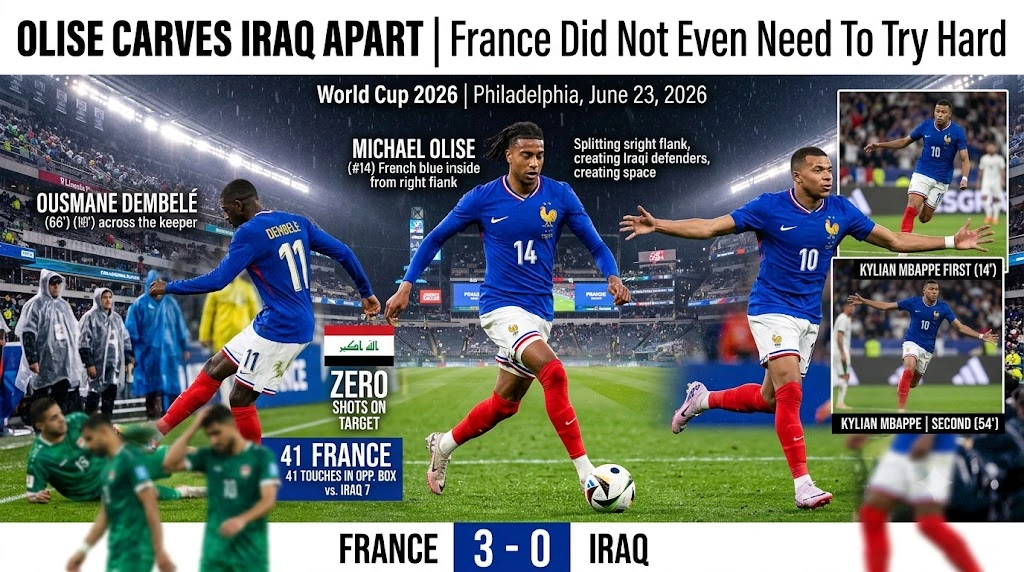
Olise Carved Iraq Apart and France Did Not Even Need to Try Hard World Cup 2026
Four things France did not need against Iraq in Philadelphia on June 23, 2026: sustained pressure, defensive discipline, set-piece creativity, or their goalkeeper. Mike Maignan faced zero shots on target. That is not a scoreline telling you France were good. That is a scoreline telling you the gap was so wide it almost stopped being a football match. France beat Iraq 3-0 at Lincoln Financial Field in their Group I fixture, with Kylian Mbappe scoring in the 14th and 54th minutes and Ousmane Dembele adding a third in the 66th. France finished with an xG of 2.67. Iraq managed 0.63. Iraq also had a two-hour storm delay to reorganize, regroup, and come up with something different. They did not.
The shape was the story. France lined up in a 4-2-3-1, with Manu Kone and Adrien Rabiot sitting as a double pivot two central midfielders who hold their positions while the team attacks and Michael Olise operating as the right-sided attacker in the three behind Mbappe. Iraq countered with a 4-1-4-1, which positions one midfielder alone in front of the back four as a shield. Against France’s width and movement, that single midfielder nominally Merchas Doski, who touched the ball 83 times but created nothing was asked to do a job that required three people.
Iraq had seven touches in the opposition box. France had 41.
Olise was the mechanism through which both of those numbers were produced. He does not run at defenders in straight lines. He cuts inside, drops a shoulder, and plays the ball before the defender can commit. For Mbappe’s first goal, Olise collected possession on the right and drove a simple, short pass inside rather than crossing. Mbappe received it already facing goal and drove a left-footed strike from 27 yards into the bottom-left corner. It was Olise’s decision to play it early that made the shot possible. A cross into the box gets cut out. A ground pass to a player already in stride does not.
Truth is, Iraq had no answer for what France were doing on that right flank because their structure gave them no way to address it. The 4-1-4-1, when the lone pivot gets bypassed, collapses into a back four facing one-versus-one situations wide. Zaid Tahseen, Iraq’s right-sided centre-back, was asked repeatedly to track Mbappe’s runs in behind while simultaneously covering Olise’s drives inside. By the time he chose one, the other had already happened. He was replaced at half-time.
France’s second goal at the start of the second half was a gift, and it is worth saying clearly: it came from an Iraqi goalkeeper error, not from a tactical pattern. Ahmed Basil botched a short goal-kick, Dembele collected the loose ball in space, and Mbappe tapped in from ten yards. 0.38 xG for that chance. It was sitting still. That moment flattered France’s numbers a little, but their overall dominance was so pronounced that the xG would have been elite regardless.
Dembele’s goal was different in character and deserves more credit than it will get. Olise, again, did the damage sliding a through ball into the right channel with a precision that split Iraq’s defensive line cleanly. Dembele arrived at the ball in stride, opened up his body, and drove across the keeper into the bottom-left. Clean, fast, confident. For all the talk about Dembele’s occasional tendency to overcomplicate things, this was exactly the kind of sharp, direct finish that makes him genuinely dangerous when the team is already ahead and the pressure is off.
Iraq found Ali Al-Hamadi as a bright point in a dark evening. He came on as a substitute in the 26th minute after Aymen Hussein went off injured and finished with 0.54 xG from three shots the best individual attacking return in the match outside of Mbappe. His header in the 27th minute, blocked from seven yards out, was the closest Iraq came to testing France in any meaningful way. It suggested there is real quality there. Playing with four attackers against France’s backline, in a different match, on a different evening, Al-Hamadi could cause real trouble. Not here. Not with this much ground to make up.
France made four substitutions after the 66th-minute goal and ran down the clock without the faintest simmering of Iraqi resistance. That is comfortable. That is total control.
For Graham Arnold, the Iraq coach, one specific and actionable change is needed before the match against Senegal: replace the single pivot with a double pivot. Doski spent the match in a corridor between France’s attack and his own midfield, watching the ball move around him. He won six duels but was bypassed consistently by Olise’s inside runs. Two midfielders sitting in that defensive central role covering more ground, covering each other’s mistakes would at minimum reduce the space France exploited so freely. Against Senegal, a team without France’s passing quality or Olise’s range, it might be the difference between elimination and a chance to survive. One holding midfielder against quality wide players is not a setup. It is an invitation.
France are through to the knockout stage. They are also, quietly, the most dangerous team at this tournament from a tactical standpoint. Not because of Mbappe though his 16 World Cup goals and counting demand their own conversation but because of what Olise does to disorganize a defensive shape before a ball has even been struck. Iraq found that out in Philadelphia on a wet Monday night, while standing under ponchos waiting for a storm to pass, with nothing to show for it at the end.
That storm delay lasted over two hours. France used the time well. Iraq did not know how.